Semiotic Review 10: Animation | article published January 2025 | DOI: https://doi.org/10.71743/xvkkzr21
Copyright © 2025 Rick Cousins CC BY-NC-SA 4.0
“Bugs Bunny? Why are you hanging around with these guys?”: Celebrity Hierarchy and Voice Characterization in Warner Brothers Cartoon Shorts 1930–1970
Rick Cousins
rcousins@trentu.ca
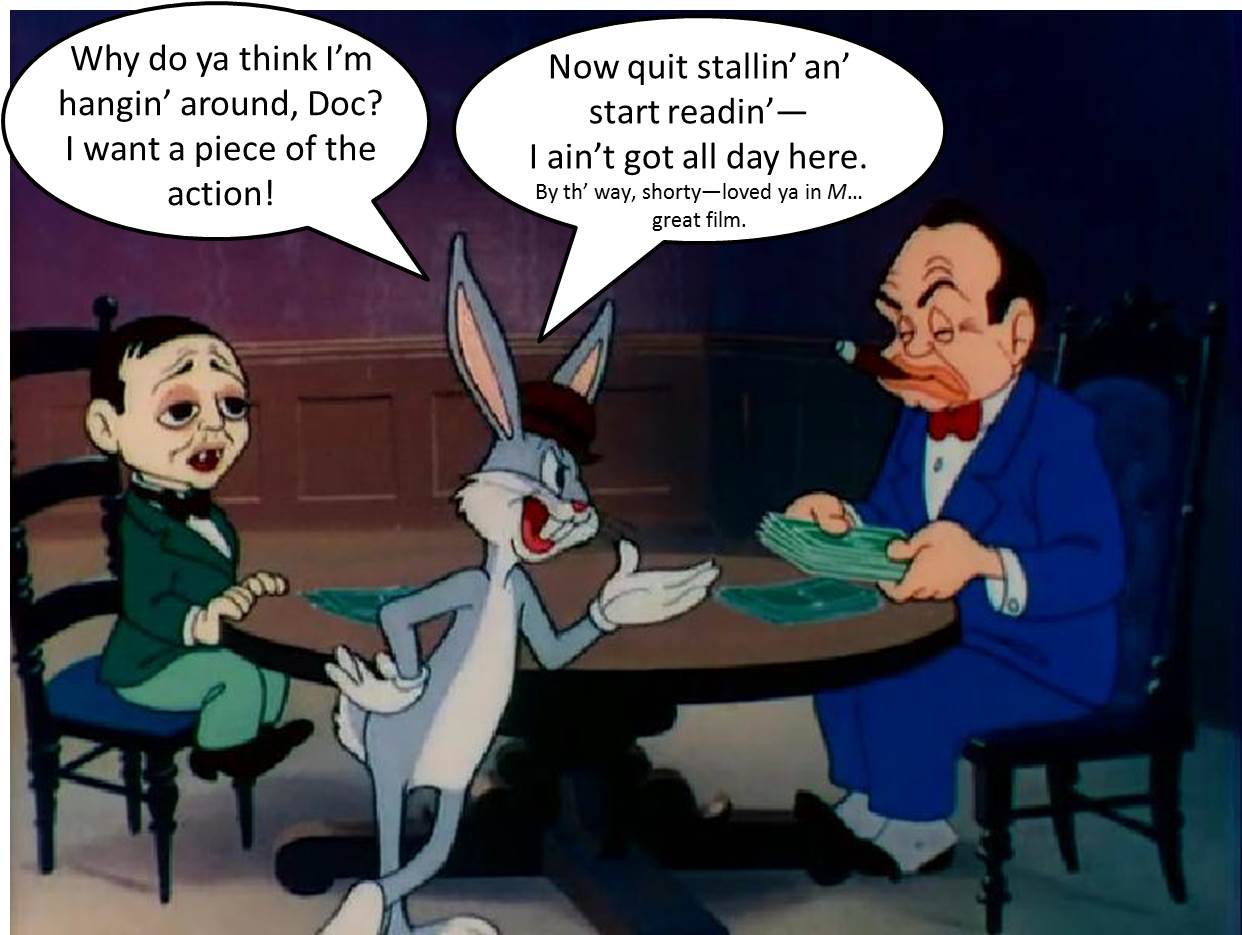
Figure 1. The author’s fanciful rendering of Bugs Bunny’s possible answer to the question in the title. Image taken from Racketeer Rabbit (1946), which features Bugs alongside caricatures of his fellow Warner Brothers stars Peter Lorre (L) and Edward G. Robinson (R).Abstract: Although animated shorts released to theatres by Warner Brothers from the 1930s through the 1960s ransacked contemporary pop culture and show business for references, catchphrases and jokes, the upper echelon of film stars was a relatively underutilized source of graphic and vocal caricature in what came to be known as the ‘house style’ for Looney Tunes and Merrie Melodies. Instead, Warner animation staff drew inspiration for their characters from lesser-known performers, in the process creating a number of enduring pop culture icons whose importance as signifiers in the film and entertainment worlds has not only obscured their original referents, but has also outlasted the cultural significance of much of ‘classic’ cinema’s Hollywood royalty.
Keywords: hierarchies; celebrity; performance semiotics; show business; comedy; animation; impersonation
Introduction
This is a study of cartoons and ghosts, but this is the last time you’ll see the name "Casper" in it. Instead, what you’ll be reading involves a process that performance studies scholar Marvin Carlson (2001) refers to as "ghosting." As much as this term may strike an intuitive chord with those deeply versed in the performing arts, the age of smartphones has made its meaning a little less self-evident for everyone else. Carlson’s "ghosting" is not about putting someone’s texts on ‘read’ and never answering them: rather, it concerns the ways in which “audience reception of each new performance [by a given actor] is conditioned by inevitable memories of this actor playing similar roles in the past” (2001:58).
In the cartoon world, animated shorts that don’t feature the friendly ghost named in the previous paragraph have a tendency to be volume dealers in the revenant department, tossing spooks at their audiences in dive-bombing squadrons, sometimes with a gratuitous ‘scare raid’ warning thrown for good measure. Perhaps then it’s appropriate that animation often produces a kind of ghosting that relies on conjuring up multiple ghosts to create its effect. Carlson again is our spectre-spotting guide, alerting us to the distinct possibility that this “aura of expectations based on past roles” may be further compounded by other factors (2001:67). If experience can condition audiences to expect to see certain actors in certain types of roles, it can also condition them to expect a certain degree of uniformity of performance from other actors who subsequently take on these roles. This creates “another level of ghosting” (Carlson 2001:77): on the surface, it can look like simple typecasting or celebrity impersonation, but its implications reach far beyond that. What’s being generated is a “complex web of intertextual experiences” (ibid.) that affects expectations pertaining not only to actors and roles, but to entire genres of text and performance.
As artistic genres go, animation is particularly susceptible to ghosted intertextual readings. Since the vast majority of animated films include a soundtrack, these readings are not exclusively triggered by what meets the eye: in fact, one highly significant category of animation’s ghosted intertextual readings is, strictly speaking, tangential to the visual aspects of the art form. A skilled voice actor contributes key elements of character that may only have been hinted at in the preparatory artwork for an animated film; for any character that speaks, these elements become crucial to an audience’s understanding of its rendered movements as a fully embodied performance. The first widely-known practitioner of animation voice acting, Mel Blanc, once described the voice artist’s contribution as part of a collaborative process through which this embodiment becomes a collective creation:
To create the voice, first they show me the picture of the character […] [As far as the process of animating the character is concerned] the voice is done first; they draw to the voice. I’ll give you an example of that: suppose that an animator is sitting at his table. He has a picture of just the outline of Bugs Bunny, and he has a mirror in front of that. He looks at himself; he hears on the phonograph record [that the character’s voice has been recorded on] “Eh…what’s…up…Doc.” He will look in the mirror and say “Eh”—draw his mouth on the character—“what’s…up…Doc.” (1nceBitten2wiceShy 2015)
Animation director Chuck Jones, who worked with Blanc during his entire career at Warner’s, nuances this somewhat by reminding people of the director’s contribution to this collective: “We would decide what kind of a person it was, and then we would have him try out voices until we got the one that was relative to that character” (FoundationINTERVIEWS 2016).
All this makes it clear that, although Blanc and successive generations of animation voice artists have frequently worked alone in the recording studio, their work has never existed in a vacuum. As Jones alluded to, the creation of a best fit between a character’s voice and its visual design relies heavily on the “aura of expectations based on past roles” that surrounds the practice of casting by physical type (Carlson 2001:67). In turn, this aura is temporally and culturally dependent: as the successes and failures of today’s reboot boom constantly remind us, audiences are more ready to accept typecasting practices which remain in current use than ones which have been resurrected from the dim, dark, distant past. The notion that an actor who is somehow a part of a greater contemporary cultural moment is better positioned to establish norms for character types also helps to explain some of the star power wielded by “the celebrity actor, whom the audience precisely recognizes on the basis of qualities outside the theatrical establishment” (Carlson 2001:86). Animation and its voice artists didn’t have to wait for Marvin the Martian, much less Marvin Carlson, to explain this to them—they’ve been exploiting the name-brand intertextual ghostly power of recognizably ‘hot’ celebrity voices since the get-go of the sound era.
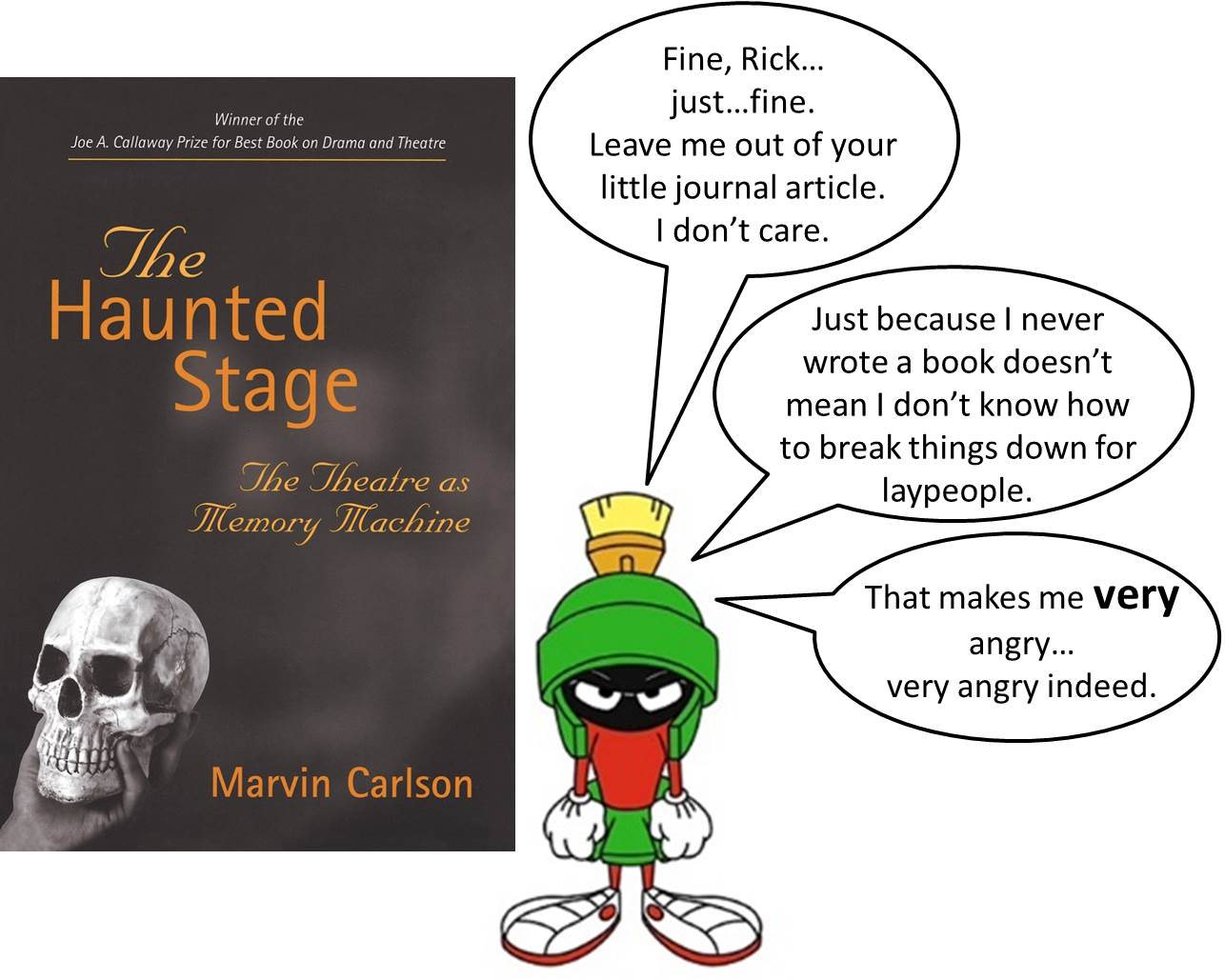
Figure 2. Marvin the Martian takes exception to being overlooked in favour of one of the seminal figures of performance studies. Assemblage of images and dialogue by the author.
Of course, "hot" and "celebrity" are relative terms, and are subject to a Law of Showbiz Thermodynamics which can make for severe, sometimes sudden, fluctuations in the temperature of any given celebrity. The title I chose for this article is drawn from a cartoon that has functioned as an illustration of this principle since its release in 1950. Midway through What’s Up Doc?, aspiring stage star Bugs Bunny finds himself sleeping rough on a park bench with a quartet of other showbiz types who are also (to use a venerable showbiz euphemism) temporarily at liberty. Bypassing them, “big vaudeville star” Elmer Fudd makes a beeline for the bunny, utters the salve amice you read when you started reading all this, then caps it off with a dismissive “they’ll never amount to anything” (McKimson 1950). This statement was meant to be taken ironically … at least from the perspective of the year 1950, CE. From today’s perspective, well … here’s the quartet of "nobodies," identified for the benefit of the undergrads of 2023 CE in a PowerPoint slide I used in a classroom lecture:
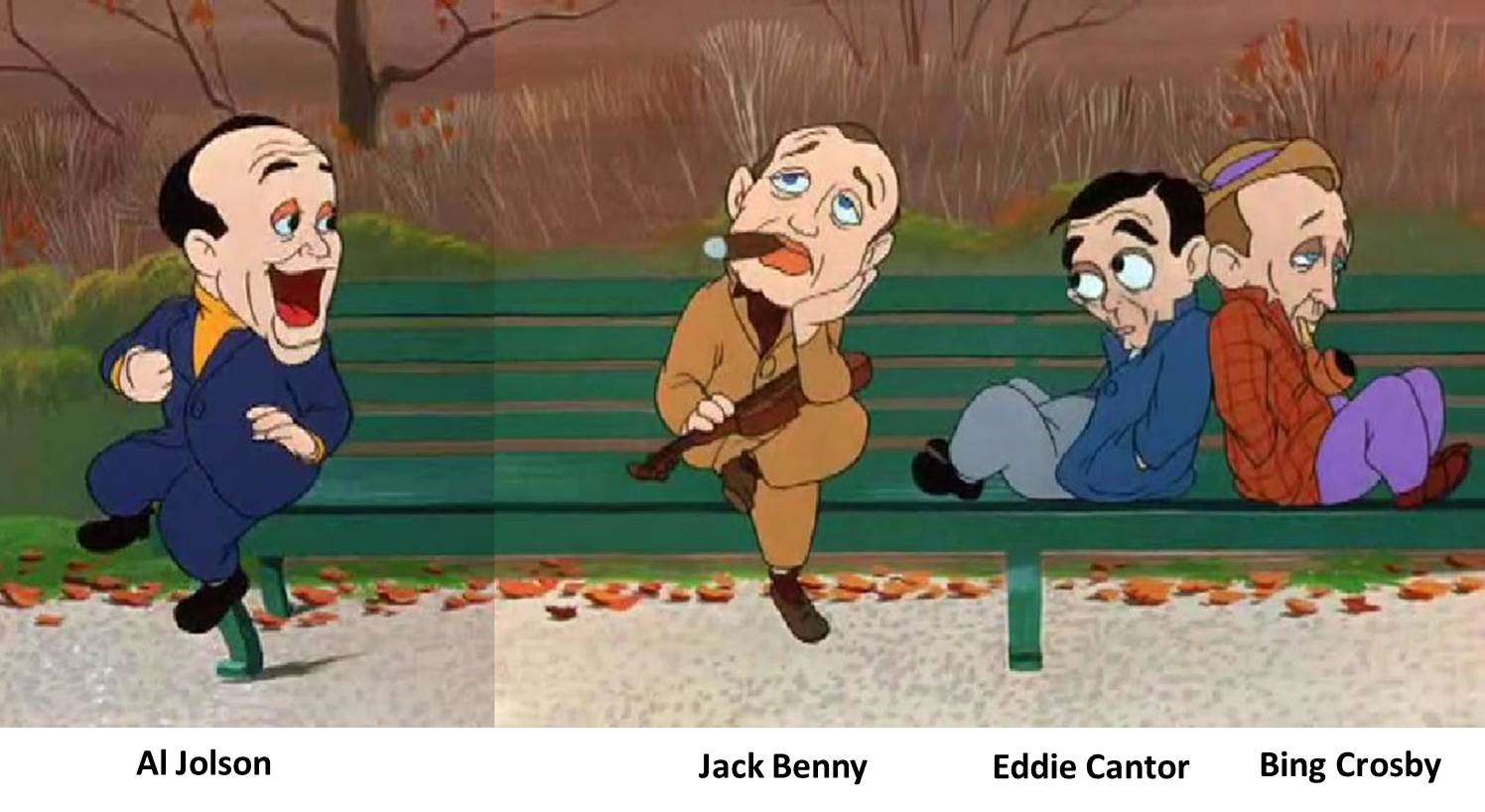
Figure 3. An image cobbled together by the author for use in classroom lectures, showing Al Jolson, Jack Benny, Eddie Cantor and Bing Crosby, as portrayed in the Bugs Bunny cartoon What’s Up Doc? (1950).
If you’re a little older, or you’re an entertainment history buff, you mightn’t need the captions… although I did get a faint glimmer of classroom recognition on Bing Crosby when I referred to him as “that dude in the YouTube videos who sings that Christmas song with David Bowie.” For the rest of the world … well, the last one of the Park Bench Gang of Four died in 1977, so "sic transit gloria mundi" is putting it mildly for all of them. There are traces of the old "sic transit" nostalgia in their use at the time What’s Up Doc? was made: survivors of a bygone entertainment era, yet still very much in the public eye, they helped to reinforce the chronology of the film’s fictional retrospective on Bugs Bunny’s career in a way that kept it up-to-date for those born after vaudeville’s heyday (or even its twilight).
Now, of course, Bugs Bunny is still on t-shirts and starring in endless Looney Tunes revivals and forgettable product-placement epics with a tenuous connection to basketball, while the Four Musketeers of What’s Up Doc? have been reduced in the public eye to pub quiz fodder. It’s probably not going too far to say that Bugs was already a bigger deal in 1950 than Eddie Cantor was. But as part of a matrix of ghosted intertextuality, Bugs also has his own character referents…and by 1950 he was already far more famous than two of them that have been said to have served as his inspiration.
And therein lies the inspiration for this trip down one of the Memory Lanes of Toontown. Although not first into talking pictures like its live-action parent company, the Warner Brothers cartoon studio can claim the distinction of being the first outfit of its kind to successfully tackle the synchronization of complex dialogue to animated characters’ mouth movements. The quality of the dialogue would take the better part of a decade to catch up to the head start this technical advance gave Warner’s over its competitors: for most of the 1930s, there really wasn’t much to distinguish what was coming out of the mouth of a character in a Looney Tune or Merrie Melodie from a character in an animated short from a lesser studio such as Charles Mintz Productions or Van Beuren. Indeed, some of the most inspired dialogue in animated shorts at the time didn’t even bother with lip-sync—or with writers, for that matter, since it consisted of muttered ad-libs from Fleischer Studios characters such as Popeye, Olive Oyl and Betty Boop.
Lip-synced or not, Popeye, Olive, Betty, and the Fleischer repertory company helped to reinforce something that would soon become a defining feature of Warner Brothers cartoons; so did Disney characters whose mouths matched their dialogue—whether you could understand what they were saying or not (sorry, Donald Duck, you know it’s true…and that goes for your nephews Huey, Dewey and Louie as well). Donald is an extreme case, but he illustrates the principle that how an animated character speaks matters just as much as what they actually say. I know I’m overstating the obvious when I say that a memorable voice goes a long way towards creating a memorable character. Under the right circumstances, it can take a character even farther than that, into that exoplanetary realm of filmic existence known as superstardom.
Before I get accused of comparing animated apples to flesh-and-blood oranges, it’s worth considering the central argument of David McGowan’s Animated Personalities (2019), which hinges on the idea that “the Hollywood live action and cartoon star share numerous common bonds” (2019:20). One of these bonds links cartoon and live action stars squarely in the voice box: the real "biggies" in both cinematic worlds have their own unmistakable way with words. If “Garbo speaks!” was the gravity-breaking thrust that propelled a silent era A-lister into the galaxy of quotably imitable cultural icons (along with many others out there who, unlike Garbo, didn’t “vant to be alone”), the disingenuous query “What’s up, Doc?” rocketed the character who said it far enough and fast enough to create two aftershocks you’re quite aware of. The first is that this catchphrase became the title of the potted cartoon biography I’ve already talked about; the second is that I don’t even have to mention his name for you to know who I’m referring to.
From Heir to Hare: The Genealogy of Bugs Bunny's Voice
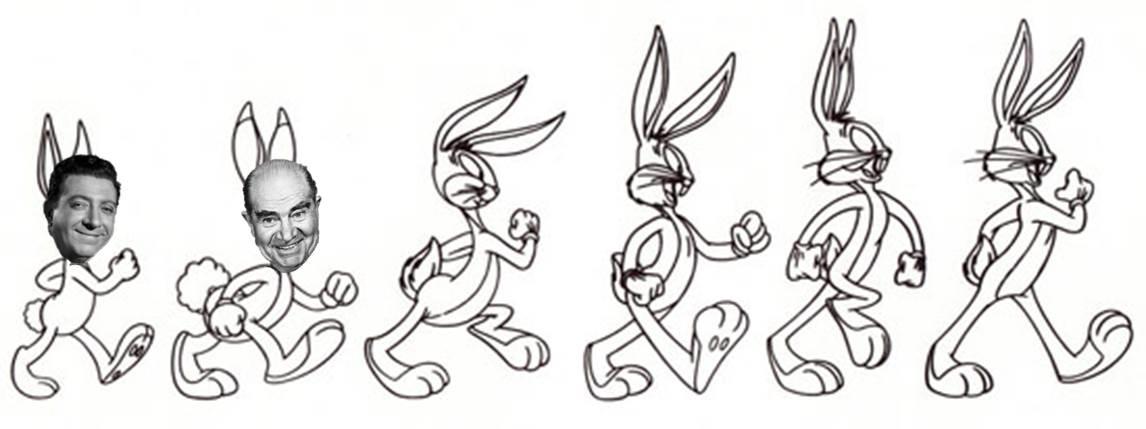
Figure 4. An adaptation of the “Evolution of Bugs Bunny” graphic, showing two putative ancestors of Bugs’ voice, Frank McHugh (extreme L) and Edward Brophy (second from L).
Of course, “What’s up, Doc?” and Bugs Bunny’s voice didn’t come out of nowhere. The knee-jerk reaction to that facile statement is “no—they came out of Mel Blanc’s mouth”, but there’s a little more to it all than that. When interviewed, Blanc was fond of giving Bugs’ acerbic intonations a geographical origin:
Bugs, I sensed, was a tough little stinker, so I thought, “which is the toughest voice in this country—either Brooklyn or the Bronx?” [in Bugs Bunny’s voice] So I, uh, put the two of ‘em together, that’s how I got the voice for Bugs, Doc. (Giller 2019)
Other bits of animation lore suggest that Bugs’ roots lie as much in Warner Brothers’ Burbank back lot as in any of New York’s boroughs. When casting about for a distinctive vocal style for the rabbit in what would come to be known as the first definitive Bugs Bunny cartoon, the 1940 short A Wild Hare, director Tex Avery claimed to have “suggested a New York wiseacre approach along the lines of Warner Bros. character man Frank McHugh” (Scott 2022:63). Keith Scott nuances this oft-repeated rabbit tale by offering an alternative, or at least parallel, casting choice: “Sometimes, however, the early Bugs voice sounds more like the New York comic hoods played by character actor Edward Brophy than the milder McHugh tones offered” (2022:63-64). If you started reading this article because you know a little voice acting trivia, you may recognize Edward Brophy’s name. He’s the voice of Timothy Mouse in Disney’s Dumbo. That’s his one and only animation voice credit, which tops McHugh’s voice credits by a grand total of one. While they were plying their respective trades in relative anonymity, Bugs Bunny was getting his likeness painted on American bombers during World War II. It’s a bloodthirsty kind of tribute to be sure, but also an indication of how quickly Bugs became embedded in American collective memory.
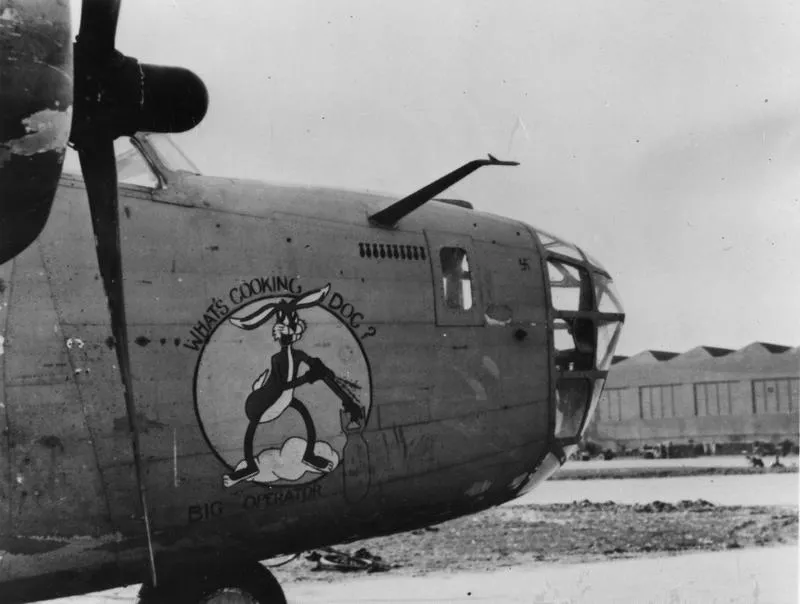
Figure 5. This is one of the insignia in question, featuring Bugs’ most widely-used variant of his signature greeting, courtesy of the American Air Museum in Britain’s website. Image from https://www.americanairmuseum.com/archive/aircraft/41-24040. Accessed January 5, 2024.
In all its Frank McHugh-ness and/or Edward Brophy-ness filtered through Mel Blanc’s larynx, Bugs Bunny’s voice is an example of a special type of Carlson’s ghosting: never openly acknowledging its source, it breaks free of its initial status as a signifier, and joins the ranks of the signified. This new status can produce interesting feedback effects: it’s worth pondering how many viewers of re-releases, VHS tapes and DVDs of Dumbo have taken Timothy Mouse to be a signifying take-off on Bugs Bunny. When someone like Bugs Bunny becomes an icon in both the colloquial, pop-cultural sense of being Kind of a Big Deal and the Peircean sense of being a Reasonable Facsimile of the Real Deal, it can be easy to forget that Bugs has never actually been someone, but only something. In the midst of all this forgetting, the relationship between this animated Something and all the real live Someones who also appear on movie screens gets cast in very sharp relief.
The idea that animation could create breakout stars was nothing new when Bugs first emerged from his rabbit hole: even before Mickey Mouse became a Depression-era merchandizing juggernaut, Felix the Cat was a Roaring Twenties cultural phenomenon. Bugs’ stardom was a little different somehow, though. Warner cartoons seemed to reflect a greater awareness of being part of the same film family as their live-action counterparts, an attitude no doubt encouraged by proximity. While Columbia, Paramount and Fox subcontracted animation work to New York-based outfits, and the two Walters (Disney and Lantz) kept separate Hollywood addresses from their distributors, Looney Tunes and Merrie Melodies were made on Warner real estate. This familiarity bred everything that family ties are known to breed: never exactly in lockstep with the gritty features Warner became known for, Warner ‘toons had a habit of providing some sort of a response to them. Small wonder then, that in an effort to keep up with what Chuck Jones described as “gentle pictures like Little Caesar, I Was a Fugitive from a Chain Gang, Dr. Ehrlich’s Magic Bullet” (qtd. in Adamson 1990:47), Warner cartoons served up parodies of both them and their stars. Warner mainstay Edward G. Robinson may have been the only "tough guy" in the studio who wasn’t in Angels with Dirty Faces, but a dog-faced caricature of him got the spotlight all to himself when Tex Avery clapped back at the gangster picture genre in Thugs with Dirty Mugs.
A lot has been said, and a lot more can be said, about Avery’s influence over all of this. For the purposes of this discussion all that really needs to be said is that once Tex became the driving force behind the style of narrative and humour that set Warner cartoons apart from all the rest, close readings of the hierarchies and politics of film genres and film performers became a consistent feature of the cartoon portion of the Warner program. In short, Warner cartoon characters not only made a point of letting audiences know that they were aware of their status as second-class citizens of filmdom, they got a kick out of making that point as many ways as possible.
For all that, they missed some good opportunities to do so. Thugs with Dirty Mugs follows a different storyline from Angels with Dirty Faces, robbing Avery of a chance to pass comment on the Warner cartoon corps’ perceived status by riffing on a group of characters from the latter-named film. The collection of young actors already known as The Dead End Kids from their appearance in the stage and film versions of Dead End function as the Greek chorus and semi-amoral conscience of Angels with Dirty Faces: initially lauding and aping the criminal exploits of James Cagney’s rising hoodlum Rocky Sullivan, they eventually forswear their misdeeds and hero-worship when Rocky feigns cowardice on the way to the electric chair (Curtiz 1938).
In relation to Warner Brothers’ live-action features (and their stars), the studio’s animated shorts (and their creators) can be seen as a sort of loose coalition of Dead End Kids: taking a secondary role to their more celebrated screenmates, they spend a noticeable portion of their own screen time drawing attention to their subordinate status, while making ambivalent statements about whether they truly deserve consideration as anything but bargain basement fare. If The Dead End Kids, under various names and with various lineups, would settle into a comfortable and recognizable niche in the world of "B" pictures, the ever-changing roster of employees at the Warner cartoon plant had good reason to wonder if they’d ever be allowed to be associated even once with anything as important as Angels with Dirty Faces.
As far as the world of film in general and the world of animation in particular were concerned, the final verdict from Warner’ s cartoon-making version of The Dead End Kids was something along the lines of Groucho Marx’s vow not to belong to any club that would have him as a member. Choosing to rule in Termite Terrace rather than serve in cinema’s rarefied heights, they operated according to their own dictates, and acted very much as a law unto themselves. This brash, aggressive, and frequently truculent form of self-policing was bound together by a firm embrace of anti-authoritarianism and disorder, which brought about a disregard for hierarchies which often bordered on contemptuous disdain. Regardless of the esteem today’s audiences may hold them in, second place always seemed to be more than good enough for Warner cartoons and their characters. Unlike Disney, they didn’t go cap in hand begging to be taken seriously: they positively gloried in being perceived as second-tier, second-rank, and even second-rate. For one thing, it seemed to suit the perception they had about themselves. Steve Schneider sums it up like this: “At Warner’s … Disney was looked upon 'with absolute awe,' Chuck Jones has said. 'We didn’t really believe we were doing the same thing'” (1990:44).
Small wonder then, that in a Warner cartoon, you’ll find a character admitting that the dud of a joke he just told wasn’t exactly "A" material by shamefacedly admitting “well, it sounded funny in rehearsal” (Avery 1938a). You’ll also find Bugs Bunny hinting that he thought he could do better in his career if he didn’t work for “the big bunch of jerks” whose names he was reading off the title card of the film he was about to star in (Avery 1941a). And you’ll find Bugs crashing the Academy Awards ceremonies and openly campaigning to have the year’s Oscar for Best Actor stripped from James Cagney and given to him (Clampett 1944).
Cagney may have been a fellow Warner contract player, but when it comes to the respect of your peers, loyalty will only take you so far. Warner cartoons never showed much loyalty to the idea that any aspect of the film industry, even award-winning performers, deserved to be put on a pedestal. The film factory that Daffy Duck infiltrates in Daffy Duck in Hollywood is the strictly-from-live-action-and-soundstage Wonder Studios, whose predictable motto is “If it’s a good picture, it’s a wonder” (Avery 1938b). Wonders abound in this short: by the final iris-out, Daffy has wangled his way into a long-term directing contract with an illogical assemblage of found footage that would make Stan Brakhage green with envy (Avery 1938b).
The belief that there is less on movie screens than meets the eye extended beyond live action into such stuff as Warner cartoons were made of. Avery’s 1941 short Porky’s Preview is an exercise in taking the mickey out of … well, not Mickey Mouse exactly, but certainly animation as practiced at the Warner studio, and the very practice of animation itself. Full of false starts, scribblings-out, and playfully childish sight gags stripped down to bare stick-figure form, the cartoon-within-a-cartoon presented by Porky Pig in this short is an interrogation of the expectations of audiences and creators alike surrounding an art form based on the central premise that doodles can be brought to life (Avery 1941b). Like the title of the film that brought Cagney the Oscar that was disputed by Bugs, Warner cartoons were Doodles, and coming from the good old U.S. of A., Yankee Doodles at that. Where they and Cagney differed is that they weren’t sure if they were all that Dandy … or if they gave a damn whether anybody else thought they were, either. As with the car rental company that was number two and therefore tried harder, being underrated made Warner cartoons have to be better at things the folks in first place felt to be beneath their dignity. Tex Avery once described some of what he felt were the virtues of this necessity:
We all knew that Disney was the king of the mountain as far as cartoons went … in my case, I couldn’t compete with Disney and I…I didn’t attempt to. I attempted to do things that Disney wouldn’t dare to do. What I’m getting at is exaggeration in films, wild takes, distorted fairy tales, and I laid off the fuzzy-wuzzy little bunnies because it wasn’t my bag along cute lines. (“Behind the Tunes: A Conversation with Tex Avery” 2004)
You Already Are in Pictures: Porky Pig, The Unwitting Film Celebrity
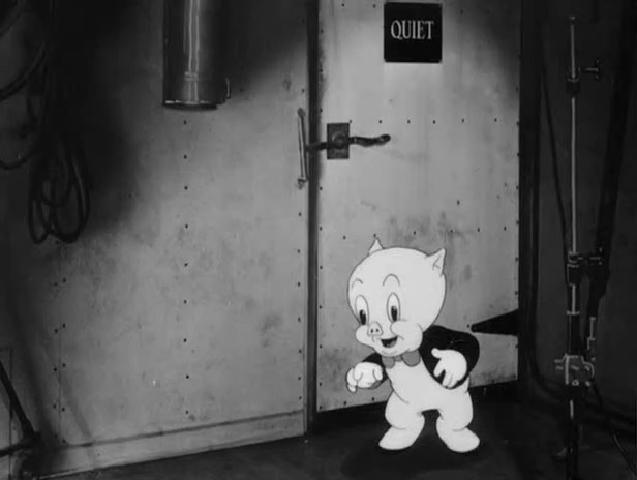
Figure 6. An animated Porky Pig trying (and ultimately failing) to be unobtrusive on a live-action soundstage in You Ought to Be in Pictures (1940).
The fight that Warner cartoons picked with Hollywood’s pecking order depended on fancy footwork for its impact. The setup for the knockout blows was a deceptively cautious two-step that alternated between belief and disbelief. Step One was admitting that ‘real movie stars’ existed somewhere other than this cartoon the folks out there in the dark were watching; from there, Step Two backpedaled, by wondering out loud just who exactly decided that things should be this way. And by ‘out loud’, I mean as loudly as possible, to anyone who’d listen. When the target of your derision stars in Technicolor swashbuckling epics and you’re stuck in a crappy black-and-white Looney Tune, it’s pretty ballsy to ask “What’s Errol Flynn got that I haven’t?” (Freleng 1940a). That’s the question that Porky Pig asks his real-live boss Leon Schlesinger in the 1940 short You Ought to Be in Pictures before setting off for the real-live Warner Brothers lot to find the answer for himself.
The answer that Porky discovers has two interrelated components: name recognition and respect. You don’t get one without the other, because names are the currency of the film world. Status is determined by how people address you, which is in turn determined by the name they use to do so. It’s like what Louis Althusser is driving at when he says that “the existence of ideology and the hailing or interpellation of individuals as subjects are one and the same thing” (2014:264). Instead of being about the coercive power of the state to subjugate individuals, however, the ideology interrogated in Warner cartoons is almost exclusively about the subjective system of valuation used to differentiate individuals. In this version of Althusserian interpellation, the name possesses unique qualities that are not necessarily matched by the physical presence of its owner. Unremarkable nobodies become instant somebodies when a name unlocks their secret showbiz identity; lookalikes can pass themselves off as these same somebodies if they’re careful not to do anything to break the illusion. This is what initially denies Porky access to the Warner Brothers studio in You Ought to Be in Pictures and what eventually gains him entry. The name "Porky Pig" cuts no ice with the guard at the front gate; a quick costume and makeup job with a derby hat and a mustache gets Porky welcomed with open arms as Oliver Hardy (Freleng 1940a).
All of this (except the fact that Hardy wasn’t ever under contract to Warner’s) made perfect sense in 1940 and didn’t have to be explained. Nowadays, we probably don’t have to be told who Porky Pig is, but we may have to be reminded that Oliver Hardy was a legitimate, bankable, name-above-the-title star, who (differences in physiques aside) had whatever Errol Flynn had at the time that Porky hadn’t. The "Mr. McHugh" the guard salutes before Porky arrives dressed as Hardy, on the other hand, is the same Frank McHugh whose fame was instantly eclipsed by Bugs Bunny. In a strange and unintentional act of prescience, this scene anticipates the time when "Porky Pig" would be the most recognizable name in a list which comprises: 1. Himself; 2. An “isn’t that the guy from … ?” fame-level character player; and 3. Half of a physically distinctive and oft-caricatured Academy Award-winning comedy team. For all that, the ghosting that haunts this little study meant that the Porky who got the official cold shoulder in You Ought to Be in Pictures was already well above the bottom rung of the celebrity recognition ladder. By 1940, he’d become the name brand, suitable-for-imitation-by-others version of the thing he’d started his film ‘career’ by emulating. And it was all thanks to his v-v-voi-v-v-voi … to the way he spoke.
This is where my account has to imitate the train of thought behind Porky’s stutter, and go off on a side trip for a little self-editing context. You Ought to Be in Pictures was by no means the first film to interrogate the concept of stardom by combining live action and animation. Mickey Mouse beat Porky to that distinction by half a dozen years when he sparred with Jimmy Durante in a segment of the MGM feature Hollywood Party (Boleslawski et al. 1934). Porky’s sojourn in live-action Hollywood, however, took him into territory that Mickey would have found very unfamiliar. For seven minutes, the befuddled pig wandered through a world of filmmakers, actors and other studio personnel that had no idea who he was, and had no reason to care. By the time he and Durante jousted for laughs, Mickey’s status as a legitimate member of the Hollywood pantheon was already a given, cemented by an "executive producer" title as the nominal "presenter" of Disney’s Silly Symphony series of one-off musicales.
And yet, the constant rebuffs Porky endures in You Ought to Be in Pictures make as potent a statement about the nature of motion picture celebrity as Mickey’s star turn with The Great Schnozzola. Some of this statement comes through retrospect: a good many of the once-bankable stars referred to in the short are now fixtures of "so you think you know old movies" trivia tests, while Porky, despite his age, remains a marketable property. Beyond that, though, the Porky Pig of 1940 already enjoyed a certain status among his live-action peers, in a way that the crew behind You Ought to Be in Pictures could scarcely imagine. Porky’s face may not yet have been as familiar as those of his cinematic contemporaries whose names get dropped during this film—Bette Davis, Errol Flynn and Greta Garbo, to name three—but his voice was certainly a candidate for the most famous of its type.
“How many types of Porky Pig voices are there, really?” is the question I’m hoping you’re asking right now. Well, the one from You Ought to Be in Pictures—the one we’d recognize as the definitive one—was the second voice that had been used for the character. The first voice has an origin story that helps to situate Porky within two performance matrices: the constellation of movie stars and the dramatis personae of character types that recurred in major studio releases during Hollywood’s "classic" era. Porky’s voice and its original source mark him as a minor player in both of these lineups.
The voice began as a one-note gag in I Haven’t Got a Hat, a 1935 Merrie Melodie that served as an open audition for Warner Brothers’ next cartoon star. I’m using the term "star" loosely here, since “after five years and one hundred cartoons of trying” Warner’s had yet to have a breakout character of any lasting note (Schneider 1990:140). The "joke" (also a term I’m using loosely) involved Porky’s inability to recite Henry Wadsworth Longfellow’s poem “Paul Revere’s Ride” without stuttering. To riff on a line from that poem’s opening stanza, hardly a man is now alive that would find that funny, but for subcontracted Warner cartoon producer Leon Schlesinger, it was (at least in retrospect) “sensational, history making, good” (Barrier 1999:330).
Another thing it would have been to movie audiences of the time was familiar—if not in its specifics then certainly as a piece of business associated with specific performers playing a specific stock comic figure. Performers who could stutter on demand found a niche in the anything-for-a-laugh world of early 20th century American vaudeville, turning a source of childhood embarrassment into a marketable adult job skill. One of the more noteworthy of these performers, Roscoe Ates, “learned that there was more money in being a stuttering comedian” than in playing the violin in vaudeville houses, and parlayed his vocal tic into a career as a character player in film and television with over 150 credits during a thirty-year career (Trav S.D. 2011). Stuttering could be part of what took you right to the top of a vaudeville bill: Ziegfeld Follies headliner Joe Frisco made no attempt to disguise his stutter when he began to incorporate more patter into his act. “Despite the stuttering (or perhaps because of it) he developed a reputation as a great wit” (Trav S.D. 2010).
The association between these performers and this type of role was well-enough established that, during I Haven’t Got a Hat’s pre-production process, director Friz Freleng “suggested a stuttering impediment like that of movie comic actor Roscoe Ates for the pig” (Scott 2022:34). You’ll notice that it’s Ates and not Frisco who’s used as a placeholder for the character type. By 1935, Frisco’s name had begun to fade from the public memory: in 1924, the Marx Brothers devoted a segment of their Broadway revue I’ll Say She Is to a series of increasingly implausible imitations of Frisco’s act; when that routine was revived and retooled for the brothers’ film Monkey Business, multimedia crooning sensation Maurice Chevalier had taken Frisco’s place in Groucho, Chico, Zeppo, and Harpo’s parodic crosshairs. Chevalier or no Chevalier, Frisco or no Frisco, Marx Brothers or no Marx Brothers, invoking Roscoe Ates meant that Friz wasn’t looking for a star—even a falling one—but a supporting player.
The "performer" initially chosen to provide Porky’s voice was the supporting player to end all supporting players. I’m using inverted commas again because I’m not sure that what Joe Dougherty did in the film world ever really amounted to performing. In his recent survey Cartoon Voices of the Golden Age 1930-70, Keith Scott (2022:34) adds to previous descriptions of Dougherty as a “dress extra” who took up space silently in Warner films and appends “makeup assistant” to his film industry CV. The full list of Dougherty’s showbiz talents may never be known, but it certainly didn’t include the ability to control his stutter for comic effect, in the manner of Joe Frisco or Roscoe Ates. According to animation historian Michael Barrier, “Dougherty’s stutter was too insistently the real thing” to be of much use as the kind of bait-and-switch comedic device which gives the audience the impression that they’re going to hear one word before hearing its often incongruous substitute (1999:31). Not only was Dougherty’s stutter unmanageable—“he would frequently use up expensive film stock during recordings in that pre-tape era”—but complaints were coming in about its offensiveness to filmgoers who were stutterers themselves (Scott 2022, 40). Small wonder then, as Barrier notes, that “Porky’s dialogue in some of his cartoons had shrunk almost to nothing” by 1937 (1999:338).
Soon thereafter, Porky’s dialogue grew back, as he found his voice in both the literal and performative sense thanks to the performer most often associated with him, Mel Blanc. While not alone in the ability to portray vocal idiosyncrasies so that they came across as mannerisms rather than defects (Arthur Q. Bryan’s original and definitive Elmer Fudd voice is another example of this), Blanc can certainly be credited for establishing this trait as part of the Warner cartoon house style. In his mouth, the pitiably tongue-tied Porky became a reflective, bemused observer who supplied running commentary that edited itself in real time. Like Bob Newhart a generation later, Blanc’s "Porky Pig 2.0" turned an apparent speech impediment into a defense mechanism brought on by the unenviable fate of being cast as “straight man to an entire unhinged cosmos” (Schneider 1990:144).
There is no indication that Blanc was asked to do anything other than to manipulate the stutter to make it a more manageable and more flexible tool for wordplay. Porky’s voice had been sufficiently well-established as an index of his personality that it was recast for the sole and express purpose of doing its job better. In Porky, Warner’s may not have created a star to rival Mickey Mouse, but they found a supporting player who could rise above the level of Joe Dougherty. Once fully realized, this retooled Porky Pig could hold his own with the likes of Roscoe Ates by displaying a versatility that transcended his intermittent inability to express himself. His voice, halting as it may well be, is the voice of reason, “stating what the audience is thinking” in a way that “makes us realize the true craziness of what we are seeing” (“All about Porky Pig!” n.d.).
All this has come to be accepted as a reputably definitive narrative of the evolution of Porky's voice, through its use in primary-source and secondary-source animation histories which rely on studio documents and interviews with directors and others who were involved in the creation of characters ab origine. Ironically, this version of events is likely more familiar to today's readers than it was to audiences who might have been alive during the heyday of Joe Frisco and Roscoe Ates, thanks to a fanciful alternative story put forth repeatedly in interviews by Mel Blanc:
They says, “he’s a timid little character”. So I wanted to be real authentic about it, so I went out to a pig farm and wallowed around with the pigs for a couple of weeks…I come back, and they kick me out and say “go home and take a bath”. When I did, I come back, I said, “If a pig could talk, he’d talk with a grunt—you know, ‘oink oink oink oink oink oink oink oink.’” [transitions to Porky Pig’s voice] M’tha-m’tha-m’tha-m’tha’ that’s why eh-b’dee-eh-b’dee-eh-p’eh-p’eh-Porky talks w-b’dee-w’b’dee-w’b’dee-eh-eh-with a grunt” And they said, “oh, great, great.” (DOOZYAnimation 2022)
The fact alone that Porky had been speaking on film for two years before Blanc was chosen to upgrade what came out of the pig's mouth puts the lie to this version of events. What gave traction to this fabrication was another fact that the character creator-based primary sources agree on. Like Bugs Bunny's voice, Porky's voice wasn't intended to be a direct imitation of anyone specific. Instead, as a variation on a recognizable character-defining vocal motif, it ghosted a type of role rather than any individual iteration or interpretation of it. Carlson describes the effect that this type of ghosting has on audiences in these terms:
(I)ndividual actors could also put their mark on a traditional character, even create a new name for that character, and thus appear again and again in a part uniquely their own and recognized and anticipated as such by audiences in each new incarnation. (2001:56)
Carlson is referring specifically to commedia dell’arte here, but the basic principle applies just as well to short-form animation, or to any other mode of live or mediatized performance that employs well-known rosters of stock figures. By putting a new twist on something that was partibus generis—one representative example drawn from an established ontological grouping—Bugs and Porky (via Blanc) became sui generis—one-of-a-kind ontological determinants, suitable for replication and reinterpretation by others. This, of course, is part and parcel with the practice of casting by type: there has been no shortage of little tough guys and smart, no-nonsense women in the movies, but there has only been one James Cagney, and only one Katherine Hepburn.
“You Were Expecting Maybe Humphrey Bogart?" The Sparsity of Actual Celebrity Voices in Warner Cartoon Shorts
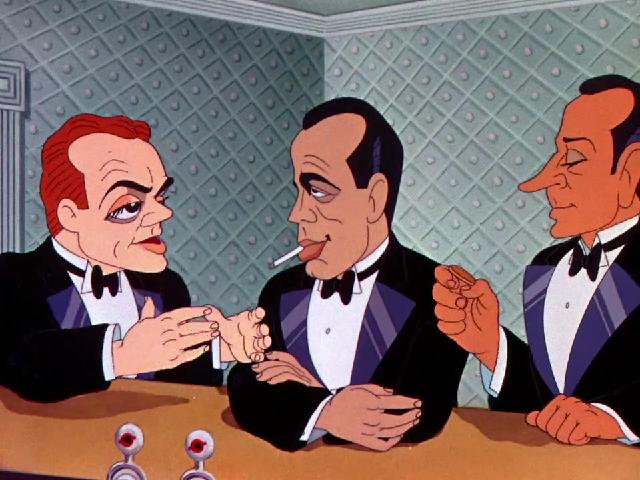
Figure 7. Caricatures of (L to R) James Cagney, Humphrey Bogart and George Raft from the 1941 Warner Brothers cartoon Hollywood Steps Out. The quote in the title of this section is not from this film, but from French Rarebit, a 1951 Bugs Bunny short in which neither Bogie nor an impersonation of him is featured.
So ... what if the voice of an animated character is used to ghost one of these more easily identifiable one-of-a-kind entertainment icons? I'm not speaking here of what happens when a specific performer is cast to perform their own iconic voice for an animated film. There is a host of examples of this, of course, and they've created a full range of ontological and hierarchical relationships. At one end of this spectrum of equivalence and being, Robin Williams as the Genie in Aladdin stands as a unique creation on an equal footing with any other role that Williams is known for. At the other extreme, Bob Newhart as Bernard in The Rescuers is eclipsed by the idea that Bob Newhart's appeal depends on him sounding like Bob Newhart whether he's playing a man or a mouse.
Leaving aside this personal and idiosyncratic reading of the Genie and Mork from Ork as peers, and Bernard as merely an avatar for Dr. Bob Hartley, it's worth noting that casting prominent name-above-the-title performers in voice roles was highly uncommon during the years that Warner Brothers made animated shorts for cinematic release. The reasons for this are hard to pinpoint. It may be that what Michael Quinn refers to as “an overdetermined quality that exceeds the needs of the fiction, and keeps them from disappearing entirely into the acting figure or the drama” (1990:155) made celebrity voices problematic for the makers of Looney Tunes and Merrie Melodies. Mel Blanc’s dominance of Warner cartoon voice tracks likewise offers only a partial explanation. His claim, “I don’t imitate people. All my voices have been created by myself” (Nick Videos 2020), is only partially accurate, beggared as it is by the reminiscences of Avery and other Warner cartoon staff about their suggestions that he take his inspiration from actors with established reputations such as Frank McHugh.
Be that as it may, Blanc was not known as a celebrity impressionist, and celebrity impressions were increasingly rare in Warner cartoons once Blanc was given first dibs at the microphone. It was even rarer for live-action performers to voice cartoon versions of themselves for Warner’s. What may be the most noteworthy example of this, Jack Benny’s turn as a rodentine reimagining of himself in 1959’s The Mouse That Jack Built, is less about star power than the power of friendship: Mel Blanc had been a mainstay of Benny’s radio and TV comedy-variety programs since the late 1940s, so in that sense it’s a very small quid in return for a great big heap of pro quo.
A caricatured, but human, version of Benny was at the centre of 1940s Malibu Beach Party, playing the combination of protagonist, antagonist, master of ceremonies, featured comedian and bemused straight man around which Benny’s radio program revolved. However, this Jack Benny was voiced by Jack Lescoulie, one of a roster of largely uncredited voice artists who were called upon from time to time when a Warner cartoon required on-point celebrity impersonations. Lescoulie was one of the handiest of these vocal pinch-hitters to get a hold of: his day job was “right on the Warner lot, at station KFWB [a radio station owned by Warner’s]” (Scott 2022:55). Most of the Why Can’t We Get a Voice Credit Like Mel Blanc Repertory Company shows up in Malibu Beach Party, dispelling the nonetheless intriguing recollection by the film’s character designer Ben Shenkman that “the principals’ voices were recorded by the stars themselves” (Crafton 1998, 108).
No matter who supplied the voice for which version of Jack Benny in which cartoon, it is undeniable that “caricatures, as well as parodies of movie subjects and Hollywood social life” (Crafton 1998:103) were bulwarks of Warner animation’s house style. Yet, even while making this claim for Warner’s as mid-twentieth century American animation’s funhouse mirror for the live-action film industry’s celebrity complex, Donald Crafton is fully aware that “the bread and butter of the studio was its stable of toon stars” (1998:104). Porky, Bugs, and the rest of their Tune Squad teammates seem to exist in a parallel universe of celebrity where their status depends in large part on the impermeability of the conceptual barrier between their plane of existence and the one occupied by celebrities of flesh and blood.
This isn’t an immutable universal rule of character-based animation by any manner of means. Early Hanna-Barbera made-for-TV shorts traded heavily on a dual understanding of their characters as separate creations in their own right and as referential, reverential riffs on contemporary pop culture icons. Exposure to Phil Silvers helps you keep up with Hokey Wolf’s flim-flammery; knowing about Jimmy Durante informs your comprehension of Doggy Daddy; Snagglepuss is just enough like Bert Lahr that Lahr sued to have an on-screen disclaimer inserted in the pink mountain lion’s side-hustle commercials for breakfast cereal (Korkis 2015). Given that a lot of the dialogue for characters that appeared on The Huckleberry Hound Show, The Yogi Bear Show, Quick Draw McGraw and others was cooked up by ex-Warner cartoon writers, maybe the question should be, “Why didn’t Warner’s bread and butter taste like that?”
Crafton offers a clue to why this may have been, and in doing so conjures up more of those pesky ghosts that keep floating around between the lines of what I’ve been writing. “Caricatures need not interrupt a narrative, but can complicate it by playing on the spectator’s prior associations about character stereotypes and patterns of behavior, and already known plots” (Crafton 1998:107). That’s ghosting, pure and simple, whether it’s Carlson or Crafton who’s spotted it in action. But maybe the verb “complicate” gives us something to hold on to that’s a little more substantial than the ectoplasm of repeatedly confirmed audience expectations that we’ve been dealing with so far. Simply put, if you’re concentrating on who’s doing a take-off on whom, and whether it conforms to an established and accepted pattern of take-offs, you run the risk of losing the plot. That’s fine if you’re watching Hamlet, Citizen Kane, or anything else with spare time to repeat its plot points in case you get distracted, but a seven-minute animated short has to keep things moving, so it’s up to you to keep up with the whirlwind tour. Crafton identifies this as a shortcoming in Malibu Beach Party and other Warner shorts which resemble a tour of stars’ homes, with no clear destination: “Caricatures are elements of spectacle, not readily assimilated into a narrative diegesis” (1998:105). Therein lies the trouble with celebrity caricature in animation as an end in itself. Live action celebrity impersonators cannot help presenting themselves to us as entities separate from the ones they’re imitating, whereas part of the artifice of animation lies in convincing us to set aside our understanding that the caricature is the product of human hands (and often vocal cords), and to read it as a self-contained, self-sufficient ding an sich. An animated short like Malibu Beach Party, with its "cavalcade of stars" format, illustrates the drawbacks of drawing on celebrity caricature for its own sake. Without another level of meaning to run interference for it, what was originally intended as an index can be translated into an icon; if enough is lost in this translation, it runs the risk of being reduced to a cipher.
Now, Bugs Bunny and Porky Pig certainly contain that extra level of meaning: even if you pinpointed the purported inspirations behind their voices, you’re not likely to create a one-to-one ontological correspondence between Frank McHugh and a rabbit, or Roscoe Ates and a pig. They are, as the saying goes, entirely different animals. But what about a character whose vocal referent was more fully transfused into the cultural bloodstream—who was, to use other terms, very much of the moment, trending, au courant, "hot"? The Warner cartoon bestiary has two noteworthy examples of this: both possess voices that have attained iconic status in the pop cultural sense of the term, and indexical status in the Peircean sense. Moreover, the iconic status of these voices is so imbricated in popular culture that it’s hard to imagine either character appearing on screen without having something to say for himself.
Let’s begin with the member of this pair who belongs to a species traditionally associated with beginnings, in the sense that its appearance is said to accompany the beginning of the day. One of Blanc’s more enduring (if not always more endearing) vocal characterizations combined elements from multiple sources in a way that makes its true lineage a little difficult to tease out. In his quest to determine the authentic origins of this particular voice, Keith Scott’s (2023) frustration with “animation studio history that is only semi-accurate or, even worse, totally wrong” is understandable, but in this context he should remember his day job as a veteran voice artist rather than his sideline as an animation historian. Scott cannot but be aware (as I am from my years doing radio comedy) that sometimes the inspirations for a voice get so scrambled through repeated use that it can be hard to remember which one is the chicken and which one is the egg.
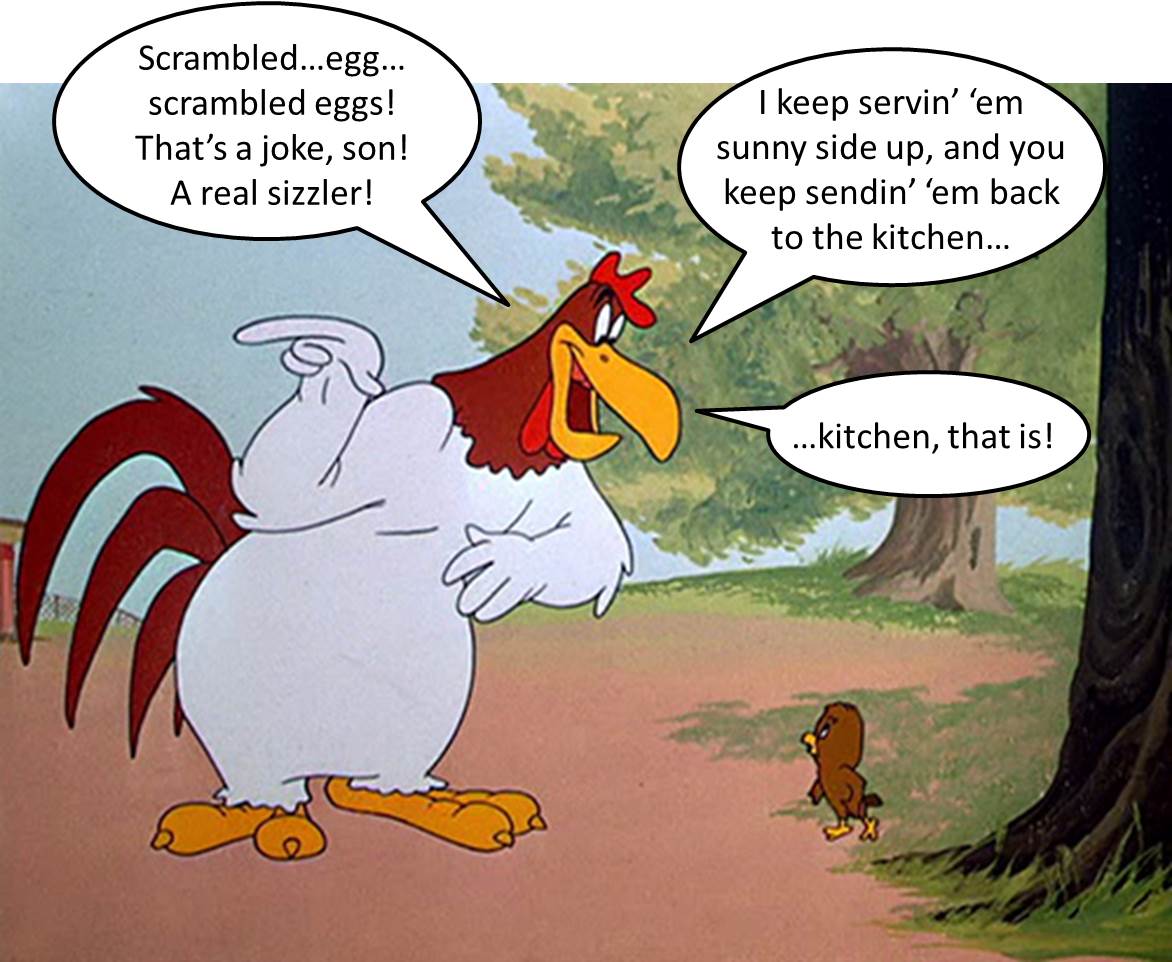
Figure 8. An image from The Foghorn Leghorn (1948), with the author’s attempt to replicate its title character’s habit of making plays on words that provide stiff competition for puns as the lowest form of humour.
If that piece of pastiche dialogue in my crude attempt at cartoon bricolage plus the reference to chickens and eggs hasn’t got you hearing—I say, hearing—a specific voice, I have no choice but to direct you to Google—search terms: “Foghorn Leghorn”—and ask you to watch a selection of the loquacious rooster’s finest cinematic moments before returning to this spot and reading on.
Will the Real-I Say, The Real-Foghorn Leghorn Please Stand Up? (Up, That Is.)
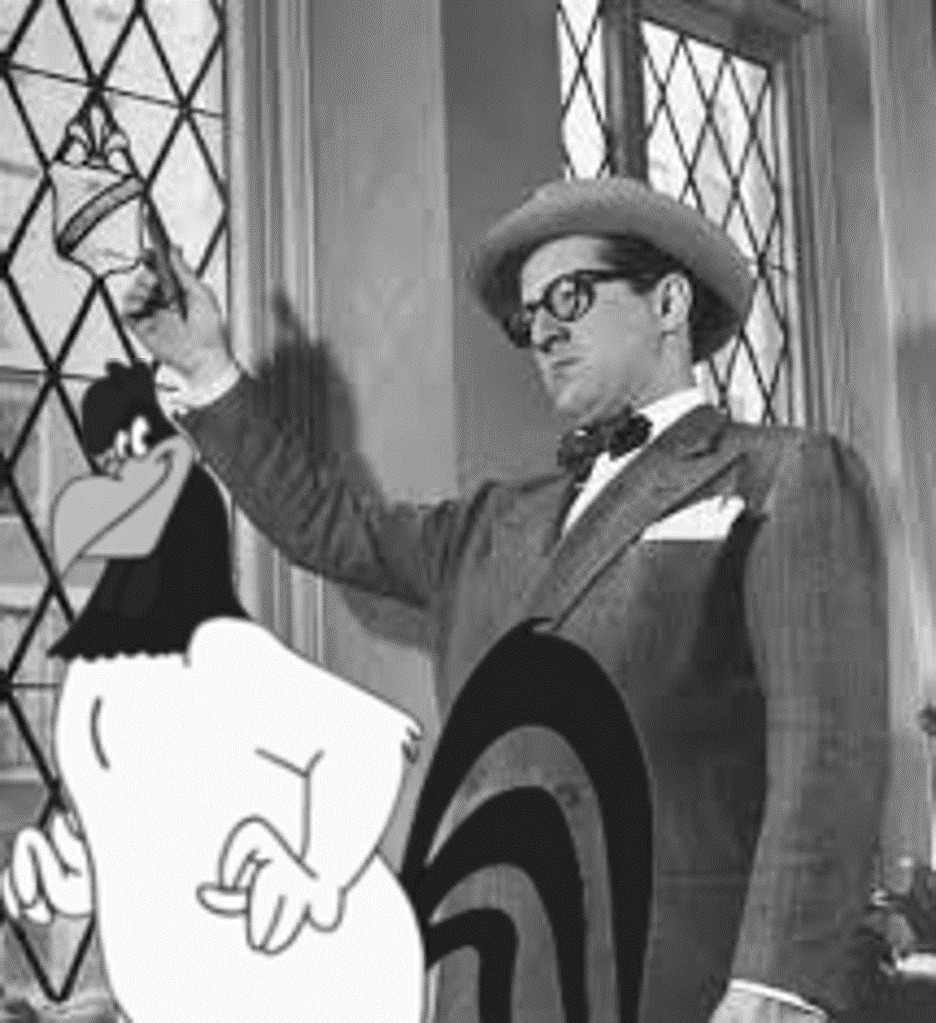
Figure 9. The author’s mashup of Kenny Delmar (as Senator Claghorn) and Foghorn Leghorn (as himself).
Now that you’ve returned (or if you never left), I’ll offer you a little animation history bricolage before giving the floor back to Scott. Thanks to Schneider, we have a succinct scrapbook-style collage in words of the origins of Foghorn Leghorn’s character and voice:
Most directly, the great white bird’s unstoppable Dixie yapping is a parody of the “Senator Claghorn from Bighorn” character played by Kenny Delmar on the old Fred Allen radio program. But director Robert McKimson—who introduced Foghorn and managed the barnyard for all his subsequent outings—also cited the sheriff character on an earlier radio show, “Blue Monday Jamboree”, as a source. Meanwhile, Mel Blanc recalled that he “took that voice when I was just a kid from a vaudeville show of a hard-of-hearing sheriff.” (Schneider 1990:216)
Like the reminiscence of Porky’s Pig’s origins in an actual sty, that last bit comes across as more of Mel Blanc being Mel Blanc, staking a claim to a voice by conflating it with a personal reminiscence, or manufacturing a reminiscence to suit the occasion. Blanc acquired a reputation at Warner’s for being “somewhat territorial” when it came to character voices, so it’s not surprising that Scott leaves the vaudeville sheriff out of his Foghorn Leghorn origin story (2022:84-85, 86). The radio sheriff, however, is still very much in Scott’s view of the character’s early development:
The hard-of-hearing old law man was created by character actor Jack Clifford. In fact the early Foghorn Leghorn was fully based on Clifford’s sheriff [from Blue Monday Jamboree], not Kenny Delmar’s Senator Claghorn. The first rooster cartoon was well into production months before the Claghorn character was ever heard on Fred Allen’s show. (2022:84)
So far so good, I say…good, that is. However, the time lag between a cartoon short’s initial conception and its release to theatres meant that developments in pop culture served to befog an audience’s understanding of which conceptual egg "Foggy" had truly hatched from. In a more in-depth examination of the issue for Cartoon Research, Scott (2023) acknowledges the temporal obfuscation and its subsequent implications. “Although a major influence on the cartoon, Jack Clifford’s Sheriff was virtually a forgotton [sic] local LA radio character by the time the cartoon was released in late August of 1946. But Senator Claghorn, ironically just ten months old, was already a national sensation” (Scott 2023).
And here’s where I circle back to Carlson—Marvin, that is—to make like an Irish conifer and opine. (Pine! O’Pine! Irish pine, that is! That’s a joke—real wearin’ o’ the grin stuff, that is!) Neither Clifford’s sheriff nor Delmar’s senator was cut from whole cloth: the tradition of comic blowhards from south of the Mason-Dixon line is a venerable one in American popular culture. Those unfamiliar with McKimson’s and Blanc’s recollections could easily take Senator Jack S. Phogbound from Al Capp’s satirical newspaper strip Li’l Abner to be the taproot of Foghorn Leghorn’s family tree. Foghorn is an example of a specific "ghosted" type: an alloy of complementary iterations of one familiar stock figure, smelted in a crucible fuelled by the public perception of whichever one of them was currently the "hottest." Mr. Leghorn, Sens. Claghorn and Phogbound, and the unnamed sheriff of Blue Monday Jamboree all play off what Carlson refers to as the audience’s “foreknowledge of traditional characters and character relationships” (2001:54). Once again, Carlson is referring specifically to commedia dell’arte, but goes on a paragraph later to broaden the scope of this effect by saying that it “can be found, in varying degrees of organizational complexity, in theatre companies throughout history and around the world” (ibid.). Even given the extensive doubling of roles asked of Mel Blanc and other voice actors, a voice cast for animation qualifies at least notionally as a “theatre company.”
To get back to the matter at hand, Kenny Delmar’s Senator Claghorn was far hotter than Jack Clifford’s Blue Monday Jamboree sheriff by the time the first Foghorn Leghorn cartoon, Walky Talky Hawky, hit the screen in 1946. That cultural heat melted the Clifford part of the alloy deep into the mix, leaving the shading Delmar gave his stock bombastic Southerner to shine through as its most visible hues. The Delmar connection also took over the audible side of Foghorn (and "Foggy" is nothing—maybe even less than nothing—if not audible). Both Clifford’s sheriff and Senator Claghorn’s speech patterns featured a noticeable degree of epizeuxis, I say, epizeuxis—repetition for emphasis, that is. However, Foghorn Leghorn cartoons made after the senator and the rooster had both emerged on the scene also employed a rhetorical device that was distinctively Claghorn’s. After a piece of tortured wordplay that almost, but never quite, reached the level of a full-fledged pun, Claghorn and Leghorn would affirm that the statement was indeed made in jest by deconstructing it, and would then proceed to cast aspersions on the mental acuity of a listener who had yet to receive an opportunity to get a word in edgewise about the humour value of anything that had just been said. Here’s an example of this from the Senator:
FRED ALLEN: What is your opinion of women in the postwar business world?
SEN. CLAGHORN: It’s uh, I say, it’s got us worried, son. Senator Glass is all broken up. […] Glass is broken—that’s a joke, son! That’s witty.
FRED ALLEN: Well, I know it is—
SEN. CLAGHORN: That’s real Southern humour! […] You, uh, you ain’t very quick, are you?
(Van Auken 2023)
And now, a rebuttal from the gentleman—uh, rooster, that is—across the aisle … uh, barnyard, that is:
FOGHORN LEGHORN [speaking to Henery Hawk]: Looka here, son, I say, son—did you see that hawk after those hens? He scared ‘em! That Rhode Island Red turned white, then blue! Rhode Island! Red, white and blue! That’s a joke, son! A flag-waver! You’re built too low! The fast ones go over your head! You got a hole in your glove! I keep pitchin’ ‘em an’ you keep missin’ ‘em! You gotta keep your eye on the ball! Eye! Ball! Eyeball! I almost had a gag, son! Joke, that is! (McKimson 1948)
To quote Henery Hawk from a later cartoon, “How gabby can a chicken get?” (McKimson 1951b) Or a U.S. Senator, for that matter…although admittedly the bar for gabbiness is set a little higher up on Capitol Hill. Despite being fed by a steady stream of hot air, Delmar’s Senator Claghorn was a flame that burned very briefly as a source of cultural heat. The indifferently-received 1947 feature film It’s A Joke, Son! failed to cash in on the character’s reputation, but also failed to tarnish it. As with many a real-life politico, what finished the Senator’s term off was, ultimately, illness—not Delmar’s, but Fred Allen’s. When poor health forced Allen out of radio in 1949, his show went with him … and with it the vehicle for a character whose one-plank platform was unlikely to secure him election to a spin-off series. With that, Warner’s resident cartoon cock of the walk not only secured the nomination to unseat Claghorn from his place in the collective consciousness, but ran uncontested.
Foghorn Leghorn had a different reason to crow than Bugs Bunny or Porky Pig, because his ghosting was on a different order. Instead of continuing to haunt a loosely delineated area inhabited by a general character type with a few specific contemporary paragons, he eventually zeroed in on one unmistakable pop culture figure, and played variations on that figure’s principal themes. The "death" of Senator Claghorn gave his "ghost" Foghorn Leghorn free reign to elaborate on these shared patterns in ways that would give animation historians the unenviable task of trying to untangle the links between the two of them to establish who was the original and who was the imitator … imitator, that is.
Putting in My Two Scents' Worth: Pepé Le Pew In and Out of Context
By comparison to Foghorn Leghorn, the other Warner character with a pop cultural–iconic/Peircean-indexical voice really stinks. In fact, compared to anything, he stinks. Mind you, he’s supposed to.
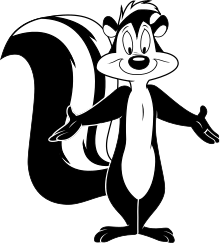
Figure 10. Le seul et unique—en anglais, the one and only—Pepé Le Pew. https://en.wikipedia.org/wiki/Pepé_Le_Pew. Accessed November 20, 2023.
The idea of Pepé Le Pew is an interesting thought experiment in character creation: how many different variations can you play on a theme that consists of only three notes? The first note is one that limited other members of Pepé’s species to spot gags in other animated shorts, with the occasional starring role in one-off efforts such as Tex Avery’s Little ‘Tinker for MGM and Arthur Davis’s Looney Tune Odor of the Day (both released in 1948). That note can be summed up in the following words: “Yeah, we get it. Skunks smell bad.” The second note is one that Avery leaned into hard when he paired his version of the Big Bad Wolf with nearly NSFW nightclub-entertainer versions of Little Red Riding Hood and Cinderella: sex obsession that defines a character’s every word and action, to an extent that would make Charlie Sheen blush.
So far, what we have is what Jeff Rovin describes in The Illustrated Encyclopedia of Cartoon Animals: a creature “so sure-footed (and sure-handed) with the ladies of any species that it’s clearly their problem when they don’t respond to his charms” (1991:202). However, it’s the third note in the Pepé Le Pew arpeggio that augments rather than diminishes the chord struck by the three of them played together. The reason it does so is deceptively simple, and therefore unsurprisingly easy to miss, because it refers to a différence, something that sets Pepé apart from his surroundings as clearly as the visible white stripe down his back and the visualized pungency that emanates from him in sickly greenish clouds. This je ne sais quoi is the very thing that would make you expect Pepé to say “je ne sais quoi” when referring to it rather than a plain English “damned if I know.” It’s not just that Pepé’s sometimes malapropistic Franglais patter reveals what Michael Lyons (2023) refers to as “his French heritage, complete with a backdrop of France” (“Love Stinks”). It’s the idea that the accent and the settings are meant by their American creators to be read by American audiences as unusual, different, special, exotic. The exotisme embraces érotisme in the same vise-like full nelson that Pepé throws around whatever tuxedo cat is unlucky enough to have backed up against a swath of wet white paint. En bref, in this interpretive context, to be French is to be, how you say in English, ze great lov-air: suave, debonair, louche, blasé to everything except la grande passion and la petite mort.
And, initially, it’s also a grande illusion. Chuck Jones’ 1945 short Odor-Able Kitty establishes the basic template for a Pepé Le Pew vehicle: a cat with markings similar to a skunk attracts the attention of Pepé’s French-farce-issue roving eye. There are significant differences in this trial run: the cat is definitively male, sports a full black-and-white paint job rather than a casually-acquired stripe, and doubles down on the skunk impersonation by slathering himself in Limburger cheese. The cat is not the only one who is not what he seems, either. Far from being a landed-immigrant Lothario, Pepé is revealed as a multi-level fraud when spotted in flagrante delicto (and also in fragrante delicto) by his wife and children (who are also skunks, not cats with painted stripes like the object of his affection). Outed by his better half, Pepé—whose name turns out to be Henry—drops the Gallic tones for something approximating Mel Blanc’s everyday speaking voice. What was going on before the jig was up was an instance of double ghosting: a mimetic performance of a specific role made famous by a specific performer … by a cartoon character who was in turn only performing a role.
Who is this specific performer, you ask? Qui est-ce? The answer was simple for the first people who saw and heard Odor-Able Kitty, but time and the speculations of those not immersed in the pop culture of 1945 have made it necessary for a return to first principles via the process of elimination. Allons-y, then, as Pepé might say, and let us commence with ze addition by ze subtraction.
Whether his identity is a put-on or not, Monsieur Le Pew (né Mr. Henry) kept finding himself in situations which exemplify the power of cultural expectations in overdetermining the performativity of ethnicity. As Kirsten Moana Thompson puts it, “Pepe Le Pew's polished performance of the charismatic French lover and his adulterous behaviors play with the adult spectator's recognition of the illicit” (1998:150). The association between Gallic charm and smouldering sensuality is strong enough that it can feel intuitively right to assign the label to any French expatriate in Hollywood, as Thompson does when she says that Le Pew is an amalgam of “the charismatic French intensity of Charles Boyer and Louis Jourdan” (1998:138). While Jourdan’s work in Gigi alone certainly makes him worthy of consideration as a characteristic purveyor of the “rhetorically seductive and emotionally expressive performances of masculinity” that Thompson sees as the defining essence of Pepé (ibid.), Le Pew’s character had been firmly established well before Jourdan had made his mark in the cinematic world, and this character had taken its cues exclusively from Boyer. Add black fur, a white stripe and a generous amount of body odor, and John Baxter’s recent description of Boyer could serve as a reasonable facsimile of what audiences would see from 1949’s For Scent-imental Reasons through 1962’s Louvre Come Back to Me!:
For generations of film and theater audiences, Boyer was the archetypal Frenchman—cultivated, courteous, and seductive, yet never quite at home in a culture not his own. The sense of loss conveyed in his murmuring baritone voice was the very essence of romance. Women longed to comfort him; men wanted to become his friend. (2021:vii)
The archetype was exploited by the Warner cartoon staff before Pepé Le Pew was a glimmer at the tip of either director Chuck Jones’s or writer Mike Maltese’s pencil. Boyer impersonations crop up in two 1944 Warners shorts—Bob Clampett’s What’s Cookin’ Doc? and Frank Tashlin’s I Got Plenty of Mutton—complete with the misremembered line from the film Algiers that would become many an impressionist’s catchphrase—“Come with me to the casbah”. By the time it and the Boyer act popped up in Odor-Able Kitty, both were firmly in the Warner cartoon grab bag of pop culture references, sitting at the ready for whenever the situation called for a quick self-contextualizing laugh. If this sort of thing qualifies as ghosting, it’s the equivalent of putting a sheet over your head and hiding behind a sofa, then jumping up and shouting “Boo!” Small wonder, then, that the object of such imitative flattery soon got sick of being haunted by it:
Boyer regretted Algiers. Generations of impressionists would make a fumbling stab at mimicking him by thrusting out their lower lip in imitation of his characteristic moue and murmuring, “Come with me to the casbah.” His sole complaint was that he would be followed and plagued by a line he never said. (Baxter 2021:102)
But for all that, there’s more to Pepé Le Pew than a catchphrase, a Monty Python and the Holy Grail-issue outrageous French accent, and monomaniacal satyriasis. His amorous escapades are still culturally relevant, in a way that Boyer’s Pepé Le Moko from Algiers isn’t, and in a way that other cartoon characters’ onscreen indiscretions don’t seem to be, either. Maybe the essential forgettability of Saludos Amigos and its sequel The Three Caballeros has obliviated Donald Duck’s insufferable lust for every live-action human female from the Rio Grande to Patagonia, but the can’t-unsee-it Harvey Weinstein level of cringe surely lingers with anyone who’s actually seen both films. Donald’s behaviour is far from an isolated case: the list of male American animated anthropomorphisms from his generation who have sexual boundary issues would fill a small encyclopedia. Unsurprisingly, though, it’s Pepé who’s been the focus of so-called "cancel culture" for his activities of six and seven decades ago. What he did isn’t as important as the fact that its residue still hangs in the cultural air, like the flower-wilting funk that trails behind his stripy tail.
It matters very little that the tipping point for disinviting Pepé from our collective cartoon party was a deleted scene from Space Jam 2 that “was apparently intended to highlight the importance of consent” (Di Placido 2021). The upshot, that Le Pew “will likely be a thing of the past across all media” (D’Alessandro 2021), is testament enough to the fact that he, his libido, and the voice that signalled the appearance of both of them, were readily identifiable "things" right up until the present.
Curtain Call: Cashing a Blanc Cheque
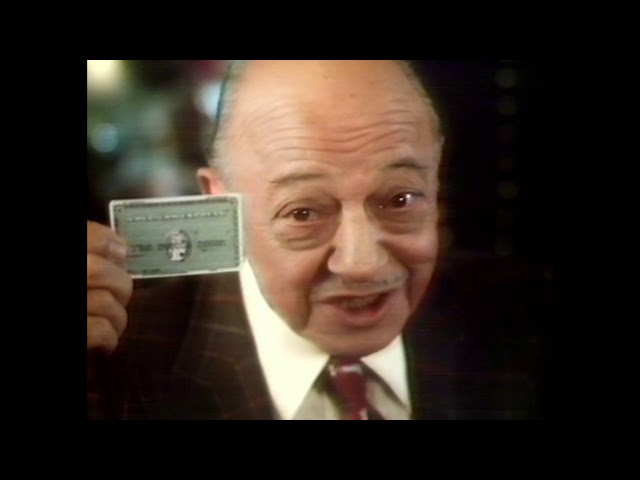
Figure 11. Mel Blanc in a 1970s vintage television commercial for the American Express card.
The question of which personages—real or fictional, live-action or animated—remain relevant enough to be cancelled, as Pepé Le Pew has been, or exploited commercially, as Bugs Bunny, Porky Pig and Foghorn Leghorn continue to be, is ultimately a question of what is signified by the hierarchies of the film world. In essence, a cartoon character is no different from a human character actor: conceptually, each one is a wage earner of the sort described by C. Wright Mills—a hireling whose success, longevity and relevance depend on “the possibilities of selling their services in the labor market” (1963:307). Their relative places in the grand scheme of things that the fickle fates of filmdom assign to the denizens of Toontown and Tinseltown may not always make a great deal of sense, but at Mills reminds us, “These varying, unequal chances are factual probabilities of the class structure” (ibid.:309).
The role of chance in creating these inequalities is further emphasized by how differently elites are selected in the dream factories of Movieland and the real factories of late industrial capitalism. Despite Mills’s qualms about the universal applicability of “functional, economic indispensability” (1963:321) as a determinant of prestige and power in society as a whole, its influence on the social substrate known as "show business" appears to be almost incontestable. Showbiz careers rise and fall based on a figure’s perceived ability to generate revenue for a production company, and can come to a crashing halt if that figure is deemed—sometimes due to unfathomable circumstances—to be "box office poison." There’s more than a little of this at work in Carlson’s concept of ghosting: give the public a taste of something they’ve already shelled out good money for, and there’s every chance they’ll line up to shell out again. In keeping with Mills’ assessment of the instability of prestige, however, there’s no guarantee what sort of reaction these ghosts may scare up once they’re unleashed. The quartet of Mel Blanc’s character voices I’ve looked at are rather unlikely to be described as “that one that reminds me of Charles Boyer,” “that one that reminds me of Kenny Delmar as Senator Claghorn,” “that one that reminds me of Roscoe Ates and/or Joe Frisco,” and “that one that reminds me of Frank McHugh or maybe Edward Brophy.” On the other hand, their ghosted inspirations stand a better than even chance of being described as “that actor from Way Back When who reminds me of Pepé Le Pew/Foghorn Leghorn/Porky Pig/Bugs Bunny”.
To complicate things even further, the passage of time has transformed Mel Blanc into one of Carlson’s unassailable primary sources for performance ghosting. It almost goes without saying that all subsequent vocal interpreters of Warner characters are judged by how faithful they are to an imagined ideal version of Blanc’s voice for any given character. As with any perception based on unquestioned folk memory, the reality is somewhat different from any ideal, imagined or otherwise: Blanc’s voices for continuing characters underwent a constant process of modification, evolution and tinkering, and were subject to his inevitable loss of vocal range and flexibility as he aged. The semi-retirement of what we now call "classic" Warner cartoon characters during the early-to-mid 1960s not only helped to give their subsequent revivals a veneer of scrutiny-obscuring nostalgia, but also helped to forgive the increasingly audible inauthenticity of Blanc’s participation in them. Simply put, the Bugs Bunny who puts in a cameo appearance in 1988’s Who Framed Roger Rabbit? betrays a septuagenarian’s vocal inelasticity, in a manner presaged by the 56-year-old Blanc’s muscle-memory-aided, going-through-the-motions portrayal of Bugs in his final theatrical release short, 1964’s False Hare (McKimson 1964).
For all this mild carping on my part about a performer playing out the string of a distinguished career, "Mel Blanc" continues to be a name synonymous with a particular performance discipline, one that encompasses the discipline so completely that it goes beyond being congruous with it, and circumscribes an area outside its boundaries. Mel Blanc is somehow bigger than voice acting, in a way that none of his most talented contemporaries and successors has a similar chance of becoming. As with anything that attains larger-than-life status, the story is (if you’ll pardon a gendered term for the sake of alliteration) equal parts man and myth. Blanc the man was not only complicit with the mythologizing: he was instrumental in its making, from an early stage of his career. In possession of an exclusive contract with Warner’s as a cartoon voice artist since 1941, Blanc negotiated on-screen credit for his services as part of an option on the renewal of his contract in 1944. As Keith Scott (2016) notes, “Giving an unseen dubbing artist name billing was definitely a new wrinkle in Hollywood,” one which gave him a leg up on his peers in the industry.
Having established his identity in the film world, Blanc wasn’t shy about defending it. Even while he was under exclusive contract for cartoon voice work for Warner’s, Blanc’s voice regularly turned up elsewhere in animation, coming out of the mouth of Woody Woodpecker, in the form of that character’s signature "ha-ha-ha-ha-haaa" laugh. Blanc had been Woody’s first voice artist, and had adapted a laugh first heard on screen from what has been labelled (for better or worse) a prototype of Bugs Bunny in the 1938 Warner short Porky’s Hare Hunt (Hardaway 1938). After Warner’s locked down his services, the laugh continued to appear in Walter Lantz’s Woody Woodpecker shorts, which came and went as all theatrical-release animated films did, with nary an extra ripple on anyone’s bank account beyond the standard cost-covering revenues from distributors and exhibitors. So far, so good; no harm, no fowl…er, no foul. However, when “The Woody Woodpecker Song,” commissioned by Lantz and using the laugh, “became an instant hit—selling 250,000 records within the first ten days of release” (Korkis 2014), the feathers began to fly:
A slighted Mel Blanc recorded an equally popular cover version and initiated a lawsuit against Lantz. Blanc lost basically on the grounds that he never copyrighted the laugh. However, before the case went to the California Court of Appeals, Lantz personally reached out to Blanc and reached an out-of-court settlement. (Korkis 2014)
This tender tale of showbiz rapprochement has an ironic coda. After the settlement—perhaps as a formal or informal part of it, perhaps not—Blanc began voicing Woody Woodpecker for Walter Lantz again, on children’s records released by Capitol. Because “Blanc’s contract with Warner did not prevent him from voicing Woody anywhere but in films […] Blanc kept playing Woody on radio and records until 1955” (Ehrbar 2018).
As important as Blanc’s halcyon days were in making his name, the sunset phase of his career was equally vital in establishing its lasting impact. The media interviews I’ve quoted from during these musings were given by Blanc in the last two decades of his life, well after the final closure of the original Warner animation studio, and generally in the interest of promoting a one-off theatrical release or television special comprised of recycled footage framed by strategically-placed new animated material. The interviews and the projects they concerned were, as much as anything else, exercises in solidifying the legacy of Warner animation, its most well-remembered characters, and, of course, its principal voice artist. Blanc also attempted to solidify his legacy through the tried-and-true method of family inheritance. In much the same way as Carlson describes the reliance of commedia and other stock figure-based theatrical styles on “character types repeated in generation after generation” (2001:59), Mel Blanc tried to pass the torch he carried between his tonsils to his son, Noel. Carlson could have warned him that this continuity is something of an illusion, given that “in every generation the familiar general types were repeated in infinite variations” (ibid.). Although he did some work as a voice actor in his own right, ultimately Noel Blanc rejected the mantle his father tried to bestow upon him:
He thought that I was gonna take over all his voices. I says, “no—nobody can take your voices, "cause they’re not built like you. You’ve got this huge chest, these incredible vocal cords, this great ear, perfect pitch, eight-octave range. Nobody’s gonna take over for you. It’s gonna take, really, a lot of people to take over for you.” (Taylor n.d.)
Blanc’s dynastic ambitions may have been misplaced, but that would hardly have been enough to unseat him from his place among voice acting royalty. As his life and career wound down, he began to be regarded among higher echelons of the show business status system as a whole. One of the more telling exercises in publicizing this status was Blanc’s appearance in a series of TV commercials for the American Express card. The concept of this long-running campaign, which exploited the name recognition of celebrities with less-than-recognizable faces, was tailor-made for Blanc, as was the some of the dialogue he spoke. Holding the card up and saying, “With this, my name won’t always draw a blank,” was a wink to the audience about the level of Blanc’s actual fame, word-playing on the assumption that audiences were familiar with the English-sounding pronunciation of his French-looking surname (Shadow Archive 2019).
It’s an open question whether Roscoe Ates, Kenny Delmar, Frank McHugh or Edward Brophy ever reached the “do you know me?” level in the zeitgeist that would’ve earned them an American Express ad, had such a thing existed in their heyday. Certainly Charles Boyer and Joe Frisco were big enough deals for long enough to merit such a cultural-memory-inspired commercial callback. But the time for such things passes, and it passes more quickly for creatures of flesh and blood than for creatures of ink and paint. The differences in the nature and order of being between humans and animated characters have been explored many, many times, from a host of perspectives; however, one remnant torn from the tattered sheet-ghost of postmodern thought neatly sums up the relationship that exists between cinema’s live-action and animated personages. For a 2016 journal article entitled “The Expanding Universe of Animation Studies”, Alan Cholodenko reanimated the hoary Derridean neologism “hauntological”, which, for all its twee po-mo archness, retains a certain à propos charm. The idea of “hauntology” calls to mind the Carlsonesque ghosting that not only establishes an animated character’s existence, but also serves to define and even justify it. Cholodenko follows “hauntological” with the words “conjuring” and “spectring”, to make it clear that the haunting and the ontology that are carried in this portmanteau are the products of teleology: when animation summons ghosts, it does so deliberately, with existing real-world referents in mind.
In essence, all animation is a form of ghosting: no matter the limits of their imaginations, animators inevitably begin by (pun intended) drawing from experience. It’s a solecism that a lot of what gets tapped into during this or any other creative process is deeply affective, and lurks at levels beneath the fully conscious or self-conscious. For all its self-evidence, this bromide is precisely what gives animation’s performative ghosting of pop culture figures an insidious, subversive power. Reducing a cultural icon to its essentials by exaggerating its most salient attributes is more than simply an act of replication or reproduction: it is a redefinition that can transform itself into a replacement. The various animation units that worked at Warner’s during its golden age may not have ever articulated what they were going after by giving looney tune-ups to A-listers and D-listers alike, but Crafton offers a glimpse into their motives when he says that:
Caricature is always double-edged. It confirms the celebrity, reinforces the popular recognition of the subject’s “star” persona (even if represented as a villain). But it is also a personal and ideological assault. (1998:102)
This assault deployed a weapon with a metaphorical equivalent that dates back to the battles of antiquity. Like Solomon and Archimedes, Warner animators used reflections, not of the sun, but of their own status, not to blind audiences, but to help them see things for what they were. As Crafton goes on to note, carpet-bombing the contemporary celluloid pantheon with simulacra of themselves gave the Warner cartoon crew “the opportunity to symbolically represent their marginal standing in Hollywood” (1998:120). Ironically, though, it may have achieved its most devastating order of magnitude when its targets were themselves marginal, or were teetering on the brink of marginality. Warner cartoon shorts used an arsenal of top talents with enduring name recognition as the raw material for one-off gags and spot appearances—Bogart, Garbo, Jack Benny, and others—but bit players, one-trick ponies and one-hit wonders were the dragon’s teeth they sowed to germinate an army of animated characters with lasting impact. Camouflaged in their guise as anthropomorphic animals, these depictions of their creators’ status-consciousness and self-concept outlived their original purpose as comments on the film industry’s status system, and began to function as parts of that system in their own right.
This status is due in no small part to the memorable nature of the voices created for them. Those of us who have tried to imitate a Mel Blanc character voice, or who know who Mel Blanc is (with or without his American Express card) can attest to the degree that the sounds he made continue to haunt our shared imagination. The fact that so many of Mel Blanc’s character voices have outlasted their source material as part of the overall pop cultural conversation is a testament not only to the place they’ve attained in the entertainment industry’s hierarchy of personas but also the place attained by their creator. Blanc’s voices, and the characters who continue to use them in the ways he established for them, remain hauntological over three decades after their originator passed over into the spectral realm, for a reason posited by Carlson while pursuing the phantoms of the performance world nearly a quarter of a century ago: “popular enthusiasm for a character may be created or reinforced by the work of a particular actor” (2001:64).
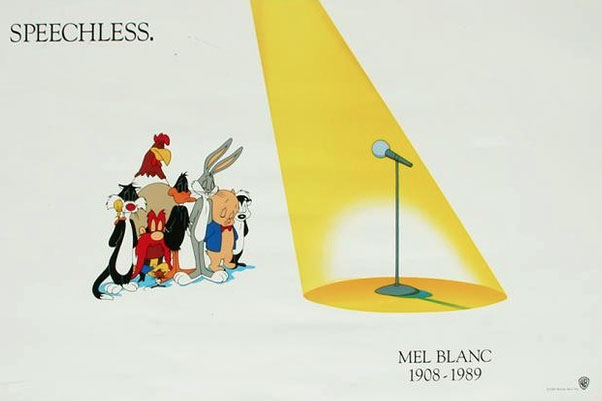
Fig. 12. One last ghost: this is the magazine ad Warner’s released immediately following Mel Blanc’s death to commemorate his life and acknowledge his body of work. Image from https://cartoonresearch.com/index.php/animation-anecdotes-302/. Accessed January 5, 2024.
Postscript
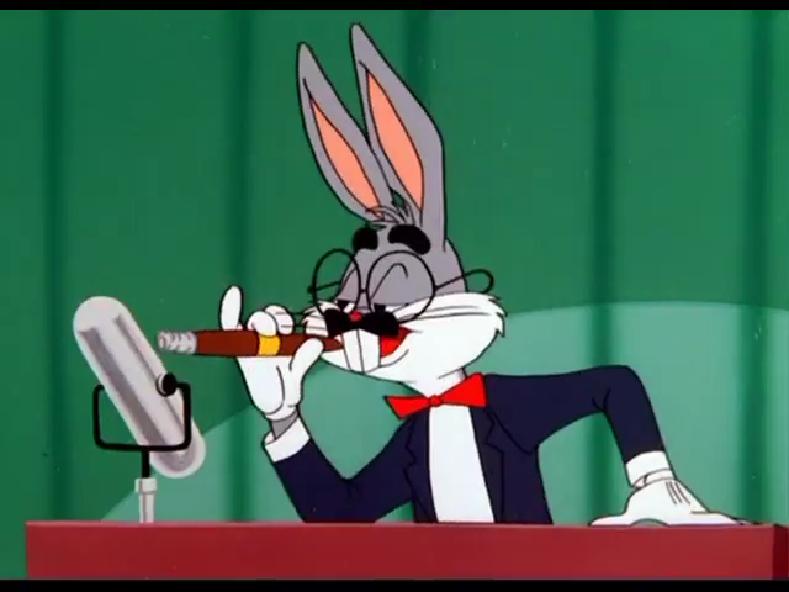
Figure 13. Bugs Bunny in Wideo Wabbit (1956), impersonating Groucho Marx from Groucho’s days as host of the television quiz show You Bet Your Life.
Here’s an extra bonus example of cartoon voice ghosting, featuring extra bonus ghosting emulsified in the original ghosting. In Wideo Wabbit (1956), Bugs Bunny impersonates Groucho Marx (who isn’t impersonating Maurice Chevalier—see above), but it’s not Mel Blanc doing his voice. It’s Daws Butler (the Mel Blanc of TV’s first generation, best known for his own line of celebrity near-impersonations as Yogi Bear, Snagglepuss, et al. in early Hanna-Barbera cartoons—also see above).
So … Daws as Bugs is imitating Groucho, but doing it in a way that suggests he’s imitating Mel as Bugs imitating Groucho, if only Mel could imitate Groucho, which apparently he couldn’t, which is why Daws is imitating Bugs imitating Mel imitating Groucho. Did you get all that? IMDb confirms this in their entry for Wideo Wabbit, and, more importantly, so does Keith Scott, in a comment on a Cartoon Research post from 2017. No wonder Bugs, like Groucho, never seemed to want to belong to a club that would have him as a member.
References
1nceBitten2wiceShy. 2015. Lost for 35 Years: Mel Blanc Interview from 1979! YouTube. July 15, 2015. Video, 29:48. Accessed September 22, 2023. https://www.youtube.com/watch?v=95eXCS0Qy2Y.
Adamson, Joe. 1990. Bugs Bunny: Fifty Years and Only One Grey Hare. New York: Henry Holt and Company.
“All about Porky Pig!” N.d. ChuckJones.com. Accessed July 19, 2023, https://chuckjones.com/characters/porky-pig/
Althusser, Louis. 2014. On the Reproduction of Capitalism: Ideology and Ideological State Apparatuses. Translated by G. M. Goshgarian. New York: Verso.
Avery, Tex, dir. 1938a. A Feud There Was. Burbank, CA: Warner Brothers.
Avery, Tex, dir. 1938b. Daffy Duck in Hollywood. Burbank, CA: Warner Brothers.
Avery, Tex, dir. 1941a. Tortoise Beats Hare. Burbank, CA: Warner Brothers.
Avery, Tex, dir. 1941b. Porky’s Preview. Burbank, CA: Warner Brothers.
Avery, Tex, dir. 1941c. Hollywood Steps Out. Burbank, CA: Warner Brothers.
Avery, Tex, dir. 1948. Little ‘Tinker. Hollywood, CA: MGM.
Barrier, Michael. 1999. Hollywood Cartoons: American Animation in Its Golden Age. New York: Oxford University Press.
Baxter, John. 2021. Charles Boyer: The French Lover. Lexington, KY: University Press of Kentucky.
“Behind the Tunes: A Conversation with Tex Avery.” 2004. Looney Tunes Golden Collection Vol. 2. Burbank, CA: Warner Home Video, DVD.
Boleslawski, Richard, et al., dirs. 1934. Hollywood Party. Hollywood, CA: MGM.
Carlson, Marvin. 2001. The Haunted Stage: The Theatre as Memory Machine. Ann Arbor: University of Michigan Press.
Cholodenko, Alan. 2016. The Expanding Universe of Animation Studies. Animation Studies 11 (2016), October 11, 2016. Accessed September 26, 2023. https://journal.animationstudies.org/alan-cholodenko-the-expanding-universe-of-animation-studies/.
The Chuck Jones Virtual Experience. N.d. ChuckJones.com. Accessed July 19, 2023, https://chuckjones.com/.
Clampett, Bob, dir. 1944. What’s Cookin’ Doc? Burbank, CA: Warner Brothers.
Crafton, Donald. 1998. The View from Termite Terrace: Caricature and Parody in Warner Bros. Animation. In Reading the Rabbit: Explorations in Warner Bros. Animation, edited by Kevin S. Sandler, pp. 101-20. New Brunswick, NJ: Rutgers University Press.
Curtiz, Michael, dir. 1938. Angels with Dirty Faces. Burbank, CA: Warner Brothers.
D’Alessandro, Anthony. 2021. Pepe Le Pew Won’t Be Appearing In Warner Bros. "Space Jam" Sequel. Deadline, March 7, 2021. Accessed November 15, 2023. https://deadline.com/2021/03/pepe-le-pew-space-jam-2-new-york-times-rape-culture-controversy-1234708688/.
Davis, Arthur, dir. 1948. Odor of the Day. Burbank, CA: Warner Brothers.
Di Placido, Dani. 2021. “Space Jam 2": How Cancel Culture Came For Pepe Le Pew, Speedy Gonzalez, And Looney Tunes. Forbes, March 10, 2021. Accessed November 15, 2023. https://www.forbes.com/sites/danidiplacido/2021/03/10/space-jam-2-did-cancel-culture-come-for-the-looney-tunes/?sh=5750ac23732ac.
DOOZYAnimation. 2022. Q&A with Mel Blanc –Origin of Characters – Porky Pig, Bugs Bunny and More. YouTube. August 9, 2022. Video, 4:00. Accessed September 22, 2023. https://www.youtube.com/watch?v=1_ovKxBcCoM.
Ehrbar, Greg. 2018. A Birthday Look at Mel Blanc’s Woody Woodpecker Records. Cartoon Research, May 29, 2018. Accessed December 5, 2023. https://cartoonresearch.com/index.php/a-birthday-look-at-mel-blancs-woody-woodpecker-records/.
FoundationINTERVIEWS. 2016. Chuck Jones discusses Mel Blanc – EMMYTVLEGENDS.ORG. YouTube. October 11, 2016. Video, 4:25. Accessed September 22, 2023. https://www.youtube.com/watch?v=XItqlgTXDqE.
Freleng, Friz, dir. 1935. I Haven’t Got a Hat. Burbank, CA: Warner Brothers.
Freleng, Friz, dir. 1940a. You Ought to Be in Pictures. Burbank, CA: Warner Brothers.
Freleng, Friz, dir. 1940b. Malibu Beach Party. Burbank, CA: Warner Brothers.
Freleng, Friz, dir. 1945. Ain’t That Ducky. Burbank, CA: Warner Brothers.
Freleng, Friz, dir. 1946. Racketeer Rabbit. Burbank, CA: Warner Brothers.
Giller, Don. 2019. Mel Blanc on Letterman, November 15, 1982. YouTube. April 12, 2019. Video, 10:30. Accessed September 11, 2023. https://www.youtube.com/watch?v=okX_ZU4B7Os.
Hardaway, Ben, dir. 1938. Porky’s Hare Hunt. Burbank, CA: Warner Brothers.
Hueck, Marc Edward. 2017. The Roaster and the Rooster: How a Comedian’s Character Was Overshadowed by his Cartoon Copycat. Beverly Cinema, January 8, 2017. Accessed October 14, 2023. https://thenewbev.com/blog/2017/01/the-roaster-and-the-rooster/.
Jones, Chuck, dir. 1945. Odor-able Kitty. Burbank, CA: Warner Brothers.
Korkis, Jim. 2014. Animation Anecdotes #168. Cartoon Research, June 27, 2014. Accessed December 5, 2023. https://cartoonresearch.com/index.php/animation-anecdotes-168/.
Korkis, Jim. 2015. Animation Anecdotes #207. Cartoon Research, April 10, 2015. Accessed September 26, 2023. https://cartoonresearch.com/index.php/animation-anecdotes-207/.
Korkis, Jim. 2017. Animation Anecdotes #302. Cartoon Research, February 24, 2017. Accessed January 5, 2024. https://cartoonresearch.com/index.php/animation-anecdotes-302/.
Lenburg, Jeff. 1999. The Encyclopedia of Animated Cartoons. 2nd edition. New York: Facts on File.
Lenburg, Jeff. 2009. The Encyclopedia of Animated Cartoons. 3rd edition. New York: Facts on File.
Lyons, Michael. 2023. Love Stinks: Celebrating Pepé Le Pew. Cartoon Research, June 30, 2023. Accessed November 1, 2023. https://cartoonresearch.com/index.php/love-stinks-celebrating-pepe-le-pew/.
McGowan, David. 2019. Animated Personalities: Cartoon Characters and Stardom in American Theatrical Shorts. Austin, TX: University of Texas Press.
McKimson, Robert, dir. 1946. Walky Talky Hawky. Burbank, CA: Warner Brothers.
McKimson, Robert, dir. 1948. The Foghorn Leghorn. Burbank, CA: Warner Brothers.
McKimson, Robert, dir. 1950. What’s Up Doc? Burbank, CA: Warner Brothers.
McKimson, Robert, dir. 1951a. French Rarebit. Burbank, CA: Warner Brothers.
McKimson, Robert, dir. 1951b. Leghorn Swoggled. Burbank, CA: Warner Brothers.
McKimson, Robert, dir. 1956. Wideo Wabbit. Burbank, CA: Warner Brothers.
McKimson, Robert, dir. 1959. The Mouse That Jack Built. Burbank, CA: Warner Brothers.
McKimson, Robert, dir. 1964. False Hare. Burbank, CA: Warner Brothers.
McLeod, Norman Z., dir. 1931. Monkey Business. Hollywood, CA: Paramount.
Mills, C. Wright. 1963. Power, Politics and People: The Collected Essays of C. Wright Mills. New York: Ballantine Books.
Nick Videos. 2020. Mel Blanc Interview. YouTube. September 12, 2020. Video, 2:47. Accessed September 22, 2023. https://www.youtube.com/watch?v=01fkKc8AcrY.
Parten, James. 2017. Quiz Show Cartoons—part 4: 1950s. Cartoon Research, May 14, 2017. Accessed January 5, 2024 https://cartoonresearch.com/index.php/quiz-show-cartoons-1950s-part-4/.
Quinn, Michael L. 1990. Celebrity and the Semiotics of Acting. New Theatre Quarterly 6(22):154-61.
Rovin, Jeff. 1991. The Illustrated Encyclopedia of Cartoon Animals. New York: Prentice Hall.
Schneider, Steve. 1990. That’s All Folks! The Art of Warner Bros. Animation. New York: Henry Holt and Company.
Scott, Keith. 2016. Mel Blanc: From Anonymity To Offscreen Superstar (The Advent of On-screen Voice Credits). Cartoon Research, September 12, 2016. Accessed Nov. 28, 2023. https://cartoonresearch.com/index.php/mel-blanc-from-anonymity-to-offscreen-superstar-the-advent-of-on-screen-voice-credits/.
Scott, Keith. 2017. May 14, 2017 (3:26 p.m.). Comment on Parten, “Quiz Show Cartoons—part 4: 1950s.” Cartoon Research, May 14, 2017. https://cartoonresearch.com/index.php/quiz-show-cartoons-1950s-part-4/
Scott, Keith. 2022. Cartoon Voices of the Golden Age, 1930-70. Orlando, FL: BearManor Media.
Scott, Keith. 2023. The Origin of Foghorn Leghorn. Cartoon Research, July 24, 2023. Accessed October 14, 2023. https://cartoonresearch.com/index.php/the-origin-of-foghorn-leghorn/.
Shadow Archive. 2019. American Express TV Ad (Mel Blanc) 1980s. YouTube. November 24, 2019. Video, 0:28. Accessed December 5, 2023. https://www.youtube.com/watch?v=nMzNJkx1NoQ.
Tashlin, Frank, dir. 1944. I Got Plenty of Mutton. Burbank, CA: Warner Brothers.
Taylor, Dallas. N.d. That’s All Folks! The Story of Mel Blanc, Part 2. The Accident, the Recovery, and the Passing of the Torch. Produced by James Introcaso. Twenty Thousand Hertz. Podcast, MP3 audio, 23:28, Accessed December 5, 2023. https://www.20k.org/episodes/thatsallfolks.
Thompson, Kirsten Moana. 1998. “Ah Love! Zee Grand Illusion!”: Pepé Le Pew, Narcissism, and Cats in the Casbah. In Reading the Rabbit: Explorations in Warner Bros. Animation, edited by Kevin S. Sandler, pp. 137-153. New Brunswick, NJ: Rutgers University Press.
Trav S.D. 2010. Joe Frisco: Vaudeville’s Premier Jazz Dancer and Wit. Travalanche (blog). March 5, 2010. https://travsd.wordpress.com/2010/03/05/stars-olf-vaudeville-127-joe-frisco/.
Trav S.D. 2011. Roscoe Ates: Stuttered. Travalanche (blog). January 20, 2011. https://travsd.wordpress.com/2011/01/20/stars-of-vaudeville-286-rosco-ates/.
Van Auken, Annie. 2023. RADIO TRANSCRIPTION – Fred Allen: “Allen’s Alley” (ca. late 1945). January 13, 2023. Video, 5:06. Accessed October 13, 2023. https://www.youtube.com/watch?v=isJnWLKIQG4.
“Wideo Wabbit.” N.d. IMDb. Accessed January 5, 2024. https://www.imdb.com/title/tt0049952/?ref_=tt_mv_close.