Semiotic Review 4: Im/materialities | article published October 2020 |
DOI: https://doi.org/10.71743/fsdnvp06 | Copyright © 2020 Shanti Morell-Hart CC BY-NC-SA 4.0
The Dish of Theseus
Shanti Morell-Hart
smorell@mcmaster.ca
Abstract: In this paper, I use the semiotic, practical, and material movements of cuisine over time to address a well-worn paradox in philosophy. Incorporating perspectives on intangible heritage, I ground the paper in linguistic approaches to foodways. By taking this standpoint, we can prod at long-standing issues of typology and temporality, as well as the iterative process of foodways generally and recipes specifically. The ancient Ship of Theseus puzzle is rooted in the physicality of objects, and can invoke subsistence as substance. But food occupies a special place given that it is equal parts material and immaterial; a meal is comprised of both tangible and intangible ingredients. If recipes "move" over time into new forms and meanings, when is the dish of Theseus no longer the dish of Theseus?
Keywords: foodways; authenticity; semiosis; materiality; intangible heritage
Introduction
The ‘Ship of Theseus’ is a well-known and very old puzzle in philosophy. The original narrative, made famous by Plutarch, goes something like this: Theseus, legendary founder-king of Athens, brought his ship into port for preservation and repairs by the Athenians. These repairs entailed replacing every plank in Theseus’s ship with new and stronger planks as the old planks decayed. Plutarch then posed this question: is the ship that has been completely replaced with new planks still the ship of Theseus? Since the initial posing of the question, other philosophers have added twists to the narrative: as the new planks replace the old, the old planks are reassembled into a nearby ship; of the now two ships, one ship is burned; or both ships are burned; etc.
For millennia, scholars inside and outside of philosophy have tackled this paradox from a number of angles. Here, I add to these considerations from the perspective of food studies, and positioned over the archaeological long durée. I incorporate approaches to intangible heritage, and ground the perspective in linguistic approaches to foodways. My imagined subject, here, is the Dish of Theseus— perhaps one among many dishes in a feast, one feast among many in ancient Greece. Borrowing from Charles Sanders Peirce (1958, 1998), Pierre Bourdieu (1984, 1990) and other scholars such as Judith Butler (1997) and Rosemary Joyce (2000, 2004), I construct a basic argument: that the semiotic movement of foods in the past led to shifts in practices and ingredients, that in turn led to semiotic movement, that in turn led to shifts in practices and ingredients, and so on and so on, in a dialogic process. By taking this standpoint, we can prod at long-standing issues of typology and temporality, as well as the iterative process of foodways generally and recipes specifically.
The ancient Ship of Theseus puzzle is rooted in the physicality of objects, and for this reason discussions of a Dish of Theseus could simply rest on a basic idea of subsistence as substance. But food occupies a special place, given that it is equal parts material and immaterial, and a dish is comprised of both tangible and intangible ingredients. These conditions thus provoke new questions: How do recipes—oral and written—"move" over time into new forms and meanings? If components, meanings, and practices are periodically replaced, then when does the Dish of Theseus stop being the Dish of Theseus? Although I primarily use the Ship of Theseus puzzle analogically, as a potential route to follow through the labyrinth of semiosis and food authenticity, at the exit I pose the question in reverse. Could a perspective grounded in the archaeology of foodways lend anything to the original puzzle of ships?
The Ship of Theseus
Over the centuries, literally hundreds of philosophers have tinkered with the Ship of Theseus puzzle, from early scholars such as Plutarch, Plato, Socrates, and Heraclitus; to historical scholars such as Thomas Hobbes and John Locke; to modern philosophers including Levi Bryant and Christopher Brown. In other disciplines, such as physics, questions of replacement and identity are addressed at a number of scales—even at the atomic level (e.g., Castellani 1998). In heritage studies, questions of replacement and identity are often couched as specific problems of conservation and preservation (e.g., Starn 2002), and linked to authenticity and integrity (e.g., Jokilehto 2006). In archaeology, we are accustomed to thinking of artifacts as proxies for identity (the ‘Beaker people,’ and similar), but in this case, the very identity of the object itself is in question.
The specific framing of the puzzle that I focus on here is the bi-directional version, where two ships are simultaneously constructed/reconstructed as old planks are swapped for new. In this version, the core question is: what are the conditions for sufficient similarity, to identify one of the two vessels as The Ship of Theseus?
Although not an exhaustive list, in Figure 1 I present many of the types of arguments that scholars have made to address this two-ship version of the paradox. I broadly group them into replacement-based arguments, text-based arguments, context-based arguments, practice-based arguments, and temporality-based arguments. Replacement-based arguments frame the key to the paradox as understanding both the nature and the quantity of the replacement parts for the two vessels. This category would include solutions such as those found in Smart (1973), where continuity of ship form and identity of ship parts are the primary criteria. Text-based arguments focus, instead, on actual physical transformations of the ships’ materials. Arguments related to the perceptions of the vessels and motivations behind replacement I group into a context-based category. This category could also include situationalist-type solutions, as in Pickup (2016), where the “true” vessel “is always relative to the situation under consideration” (2016:973), and thus the solution rejects “universal transference of propositions across situations” (2016:988). In practice-based arguments, the key to the paradox is actual operation of the vessel, and to what extent the ship works like Theseus’ ship. Temporality-based arguments address how the basic qualities of time itself impact definition.

Figure 1. The Ship of Theseus: a taxonomy of arguments
In the interest of space, I do not address each of these categories fully, but I will note that there are semiotic themes threaded through several of them. Replacement-based arguments focus on substitutions that carry the same value, which can include icons, indices, and symbols (both material and immaterial). Context-based arguments include those that focus on perception, which gets at the overall symbolic status of the ship. Practice-based arguments may include icons, indices, and symbols, so long as substitutions ensure that the vessel operates in some way as Theseus’s ship.
In this paper, however, I focus on the temporal arguments, that is, on the importance of time itself in semantic movement, identity, authenticity, and intelligibility. We could start by borrowing from Judith Butler (1997), to explore the citational chain of the ship— and consider the “performance” of Theseus’s ship as always, effectively, a citation, whatever the form of its iteration. We could also borrow from Levi Bryant (2012) to talk about temporal movements as a sort of forward procession of entities (similarly framed in Bryant 2011). In his writings, Bryant specifically responds to the work of Theodore Sider (2003:xiii), where “objects have temporal as well as spatial parts.”
Regardless of our entry point into the ship paradox, scale is an important factor, in terms of understanding spatial relationships, associative properties, assemblage elements, dynamic entanglement, and temporality. We could think of the way that we identify a part of an object as analogous to the way that we identify a moment in time. There is little argument against our own composition of smaller parts—cells, atoms, quarks—and even the distributed and entangled nature of our selves (Gell 1998; Latour 2005) is less frequently disputed. Arguments rooted in temporality, however, are trickier to conceptualize. Theodore Sider (2003) frames objects not as temporally bounded entities but rather as “spacetime worms” that are also conceptually contingent. As he puts it, "From… traditional puzzles about identity over time, a powerful case emerges for postulating a four-dimensional world of temporal stages. If we believe in four-dimensionalism, we can dissolve these and other puzzle cases; if we do not, we are left mired in contradiction and paradox" (Sider 2003:10). Temporal contingency and temporal scale thus factor heavily in how we view the transitional nature of either ship.
Many solutions for the bi-directional version of the paradox neglect the middle or transitional stages. Instead, most focus on the initial object (Theseus’ ship) and end products (two ships). Temporal arcs, however, are equally important considerations. Transitive properties—bridges of intelligibility at any given point in time—allow one or both ships to “absorb” new parts, but these transitive properties (by nature) can only unfold over time (see also Gosden 2005 for parallel arguments about the importance of historical trajectory, alongside form and perceived source of an object). In the classic puzzle, the Ship of Theseus absorbs or loses planks relatively slowly. But if we simply switched the ships—say, floated the Ship of Odysseus around to the other side, and brazenly parked it in the spot marked “Ship of Theseus”—there would be no paradox, as the new ship would immediately be considered an imposter. Transitive properties are important, and necessarily involve time to take root in meaningful ways. Transitive properties also rely on juxtaposition: as Theodore Sider has put it, for “each [ship] candidate… were it not for the existence of the other, it would be the original ship. Each ship bears certain relations of importance to the original ship" (Sider 2003:145). That said, transitive properties themselves aren’t absolutes, but are rather constituted of historical trajectories and contextual contingencies; the viewer’s identification of a coalescence of elements.
Given the movement of time, appeals to authenticity could also be balanced with basic appeals to intelligibility. Does one ship have particular qualities that nudge it toward a Ship of Theseus that “makes sense” as a Ship of Theseus? Such deliberations might be similar to those found in Harman (2012), where intelligibility is considered in regard to sensual qualities of objects (in this case, zebras and sound waves). Or does the title “Ship of Theseus” require that we rest on a singular, authoritative, definitive, and authentic Ship of Theseus definition? Charles Sanders Peirce could add some light, here, in terms of understanding a Ship of Theseus meaning. First, a Peircian approach would not limit semiosis to language, but rather consider a broader field of sign production and interpretation, encompassing ships as much as texts. Second, as long as the Ship of Theseus is perceived as an icon, index, or symbol to the preservers, some measure of perceived authenticity would be maintained for these preservers. Third, just as in parallel examples from linguistic studies, meaning does not so much rest in the structure of the thing as much as flicker in the situation of the thing. So an ‘authentic’ Ship of Theseus, like other signs, is (to put it somewhat tautologically) immersed in active semiosis.
To use a more contemporary analogy, we could also consider Menudo, a Puerto Rican band that has entirely replaced its members—several times over—during its seemingly eternal lifetime. It’s been forty-odd years since Menudo was first formed, and none of the original members remain. So what still makes Menudo Menudo? As with Theseus’s ship, there are many ways to approach the question. What does the contract say defines Menudo as a corporate entity, what do the lawyers say on Menudo’s behalf, what does the audience say about Menudo’s performances, what does the tour bus say on the side…? We could argue, as with the two ships, that there are certain “bridges” of intelligibility; certain threads of consistency that anchor a core Menudoness that persists over time. That being said, replace the entirety of Menudo overnight, and you have serious problems. Along with some truly terrible solo albums.
But we could also turn to menudo, the Mexican stew that is equally timeless yet endlessly flexible (Figure 2). What makes the paradox of ships (and boy bands) easier to conceptualize is the tangibility and the relative durability of the materials in question. Planks are tangible; people are tangible. But food occupies a different topology: it is both tangible in its substances and effects, and intangible in its meanings and significations. It is manifested in great feasts, monumental agricultural terraforms, and elaborate funerary offerings, as well as in daily and ordinary acts of eating, planting, and disposing. (Similarly, “objects,” in Peirce’s formulations, can be tangible and intangible; can occupy different positions in the triad of sign, object, and interpretant.)
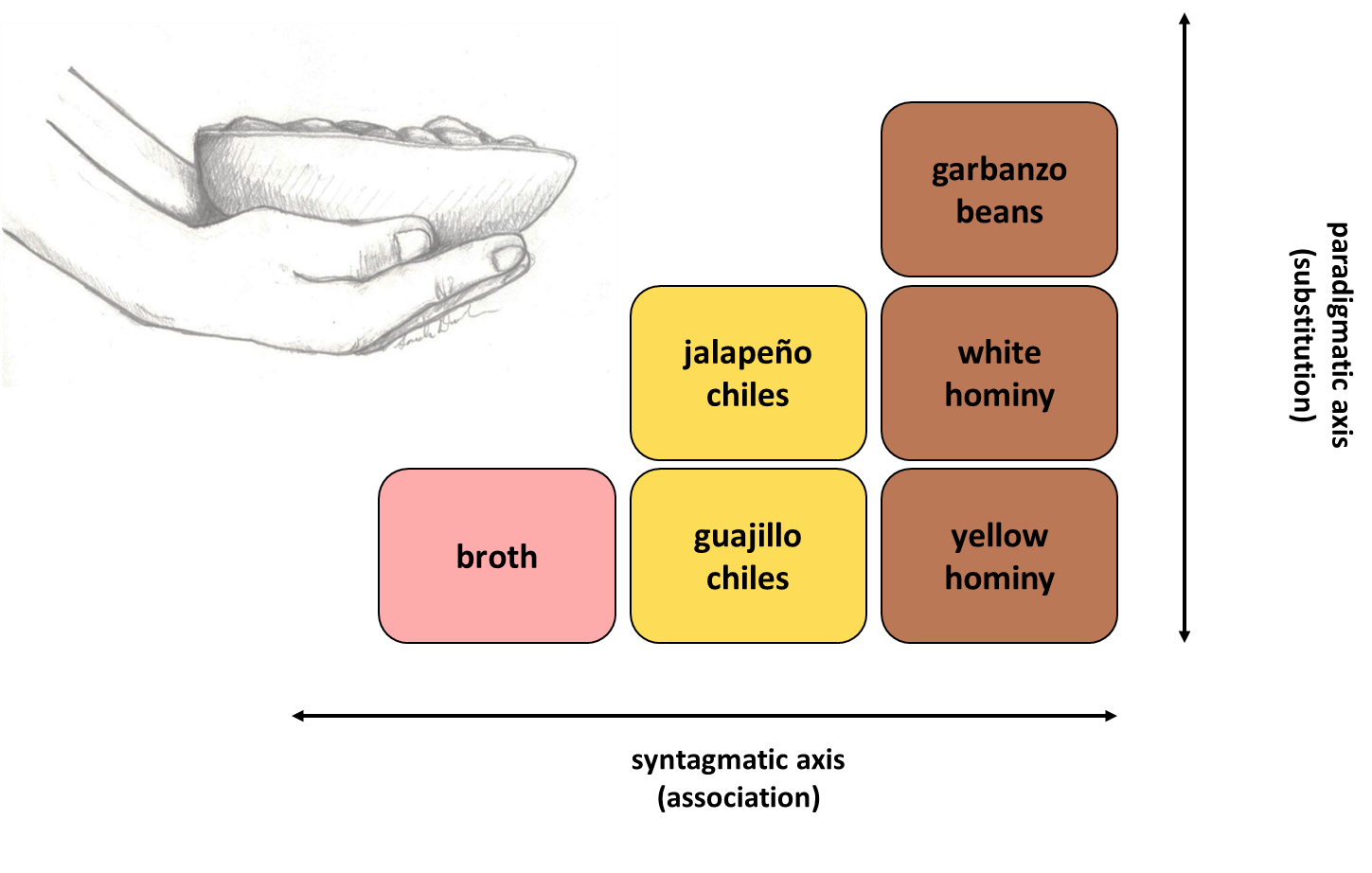
Figure 2. Menudo recipes: associated (syntagmatic) and substituted (paradigmatic) ingredients (illustration of hands and vessel by Sarah Davidson)
Moreover, if we considered the Ship of Theseus to be comprised of substances, not things, this approach would add an additional complicating layer. As Hahn and Soentgen put it (2010:8): “Some things can be dismembered or in some cases even be cut without losing their identity…. [but] because [all] substances can be divided into portions, it logically follows that one and the same substance can occur in several places simultaneously.”
Food possesses all of these properties: intangibility, composition of substances, and temporal fluidity. Recipes can feel timeless, even ahistorical. But every reiterated dish has both a history and a presence. Recipes can act as interpretants; can encompass past foods, present inscriptions, and future intended foods. In this way they become four-dimensional (similarly to arguments by Sider and Bryant); material and immaterial (similarly to arguments by Peirce). The intelligibility of foods thus relies on deixis (similarly to Hanks 2011)— in relation and perspective, both past and present. That is, just as in William Hanks’s (2011) work to understand the intersections between social setting and linguistic distinctions (“here” vs. “there;” “now” vs. “then”), successfully iterating a dish relies on a surrounding social situation—itself historically constituted—that is conducive to making sense of the dish and consuming it.
Authenticity, Identity, and Dishes
I follow a basic assumption, here, borrowing from David Lowenthal (2015): that some measure of “authenticity”, however calculated, has value to people in the present, and had value to people in the past. Multitudes of tangible objects are imbued with a deep significance that is predicated on some understanding of originality and authenticity (Dudley 2012). These understandings may be at a personal or even societal level. But what happens when we contemplate the authenticity of food?
First, we would establish that food is part consumable, but also has durable properties. We could even consider these durable and consumable properties simply by exploring a description of actual dishes consumed by Theseus (or his near contemporaries, anyway):
“…There were black-puddings and large boiling slices
Of well-mix' d sausages, which hiss'd within
The smoking streamlet in the stead of oysters.
There too were cutlets of broil'd fish well season'd
With sauce of every kind, and cook, and country.
There were huge legs of pork, most tender meat,
Loading enormous platters; and boil'd pettitoes
Sending a savoury steam; and paunch of ox;
And well-cured chine of porker, red with salt,
A dainty dish, on fried meat balls upraised.
There too were cakes of groats well steep'd in milk,
In large flat dishes, and rich plates of beestings. […]
What will you say then when you hear the rest?
For roasted thrushes nicely brown'd and hot
Flew to the mouths o' the guests, entreating them
To deign to swallow them, besprinkled o'er
With myrtle leaves and flowers of anemone,
And plates of loveliest apples hung around
Above our heads, hanging in air as it seem'd.“
(Description of “foods of the ancients” by Pherecrates, in Miners, ca. 400 BCE, quoted in The Deipnosophists; or, Banquet of the Learned of Athenæus by Athenaeus ca. 228 CE, translated by C.D. Yonge [1854] )
An archaeological study, using this description as a guide, might seek out durable elements such as sherds from “large flat dishes,” bones from “paunch of ox,” starch grains from “cakes of groats,” and lipid signatures of the milk that “steep’d” these cakes. We might seek out these durable residues in previously-identified cooking and serving spaces, and identify spaces based on durable features like ovens and hearths. Non-durable elements, however, would be more difficult to pin down. The banquet description by Pherecrates, passed through at least three sets of hands and over several millennia, gives us only a glimpse of the culinary practices at play: browning thrushes; sprinkling myrtle leaves and anemone flowers; suspending plates of apples. There is only a hint, as well, of perceptions and judgments of food—expressions of doxa (sensu Bourdieu 1984, 1990) including “nicely” brown’d, “loveliest” apples, “well-mix’d” sausages, “well-season’d” fish, “savoury” steam, and “dainty” dishes.” Although only a tiny sliver of culinary practice, in this description we already see the interplay of durable and non-durable elements, and any attempt to recreate these dishes of Theseus would rely on both durable and non-durable aspects. How to brown a thrush “nicely”? How to steep cakes of groats “well” in milk? And what are the conditions each dish must meet, to truly be a dish of Theseus?
The juxtaposition of elements and the relationship between durable and non-durable qualities moves us toward long-standing issues in archaeology related to typology and temporality. What tends to confound us, generally, is the iterative process of materials. Heirloom objects do not carry the same meanings always, and are not used for the same purposes always (Joyce 2000). Objects may be used to materialize memory, and provide basis for memory and social reproduction, but reproducing durable objects never produces identical objects or meanings. Even when the production of objects is directed toward a specific purpose, unexpected qualities of the materials themselves may lead to shifts in how objects are understood over time; a series of “unintended consequences” of production and in meaning that become a new template for reproduction (Joyce 2004). The extended iterative chain of material generation leads both to happy mistakes and grave errors. Reproducing a recipe is therefore a problem of matching homonym and synonym. If it looks like a duck, and quacks like a duck, is it… a respectable ‘rich plate of beestings’?
Although every dish is an iteration—a copy—oral and written recipes alike engender some fixity as paradigms of food categorizations (the role each ingredient plays) and syntagms of food associations (the ingredients that may be combined). Moreover, substances can have some fixity in terms of divisibility into identical aspects (Hahn and Soentgen 2010). If we follow the movement of a recipe over time, we follow the movement of intangibles that are iterated/reiterated as tangibles. When it comes to recipes, whether written down, recited, or observed, the sometimes ephemeral nature of food (solid, yet consumable; physical, yet firmly grounded in ideas of what food should be) leaves us with the typological movement that inevitably happens with duplication. The reproduction of dishes, and replacement of ingredients in them (Figure 2), results in consumable substances, not objects meant to be reused after consumption (which frankly would be a bit gross). Due to the necessary re-creation of tangible, physical dishes from meal to meal or event to event, we see drift, over time, in recipes.
We could view these shifts from the perspective of basic survival—what is considered treasured food may be contingent upon what is available in a given ecological framework during a famine (Minnis 1991). Or we could view these shifts from the perspective of gastronomy—what is considered treasured food may be contingent upon the tastes of guests at a royal feast (Bray 2003; Gumerman 1994). We could also consider various strategies of mediation that are directed toward maintaining cherished versions of dishes. Such strategies include seasonally-vulnerable people storing preferred ingredients in underground pits during times of food insecurity, rather than diversifying their foodscape (Wagner 2008), or displaced people risking arrest or even death to reclaim abandoned treasured foods in war zones (Dunn 2018). The sensory qualities of food compel efforts to sediment cherished dishes in the culinary lexicon, given that food, through these sensory rotes, offers such a profoundly intimate route to memory (Sutton 2001, 2013) and even simply normality. But ultimately, change is inevitable.
There is space for any number of perspectives when we think about change, authenticity, replicability, and the implications for cuisine. Returning to the (again, not exhaustive) types of approaches to the Ship of Theseus paradox, many of the same approaches are valid, with some modification, for understanding the Dish of Theseus instead (Figure 3). As with the ship, we can think about what it is, exactly, that Theseus’s dish represents. Is the dish of Theseus a specific set of instructions, combination of ingredients, collection of meanings, set of practices? Is the dish of Theseus a specific historical entity? Is the dish of Theseus only extant when juxtaposed with other dishes?

Figure 3. The Dish of Theseus: a taxonomy of arguments
If we consider Theseus’s dish to be a set of instructions, our focus would be on the extant structure (more in the Lévi-Strauss [2013(1966)] sense) or active structuration (more in the Anthony Giddens [1984] sense) that guides available options. Archaeologically, we could consider persistence of recipe forms and replacements within them, as indexed by differences in food technologies and residue assemblages over time. We could establish a single dish of Theseus event, never to be truly repeated, or decide when the instructions had sufficiently shifted to merit a new and differently-labeled recipe.
If we consider the dish of Theseus to be a set of ingredients, focusing on the nature of replacement materials and differences in their qualities, we would pay even closer attention to assemblages of food residues. We would think about the rotting of food, here, in place of the rotting of wood planks. Viewing sets of ingredients over the longue durée, we could track how contexts, both ecological and social, helped to maintain or transform the availability and usability of certain ingredients in the Dish of Theseus. The social context might include tastes for particular ingredients, formed in relation to class, gender, and other axes of identity (e.g., Bourdieu 1984[1979]; Mennell 1997[1987]), while ecological contexts might include availability of particular ingredients, in relation to season, hydrology, and other conditions of habitability (e.g., Kirch 1994; Minnis 1991).
If we reframe Theseus’s dish as more of a flow of practices, then we would use the same sorts of food traces while instead focusing on recipes as iterations, and the reproduction of recipes as an iterative process. This approach has been taken elsewhere in terms of archaeological ceramics (e.g. Roddick and Hastorf 2010), mud brick (e.g. Tung 2008), and other sorts of durable materials. Such an approach might evoke the chaine operatoire (or ‘operational chain’) of practice (Leroi-Gourhan 1993), as a sort of flow chart of options selected and declined. In this framework, each node leads to another set of options, opening some avenues while blocking others. In a culinary ‘operational chain,’ recipe transformations to the Dish of Theseus in the past would be tracked as preparations chosen or rejected, or perhaps viewed as simply a natural consequence of the unfolding of time.
If we focus on the dish of Theseus instead as a set of meanings, we could consider the movement between icons and indices of foodways. This perspective would contrast, for example, attempted reproduction of the “original” American Thanksgiving feast with reiterating an index of Thanksgiving feasts, steeped in the American origin mythos. In such cases, how does the change in meaning impact other aspects? And does this change in aspect result in a categorical transformation? In the archaeological record, we might look at the relative prominence over time (and space) in certain kinds of ingredients, and address shifts in roles as related to semiosis, and what a particular dish means at different scales of time and place. So, for example, we might view the substitution of maize for acorns over time in the lexicon of ancient Mesoamerican cuisine, considering how acorns came to be seen as famine foods while maize took on both a consumable and spiritual role. Or, as I have considered elsewhere, we might view the substitution over time of maize for root crops as a shift in the paradigm of ‘starchy foods’ and associated meanings (Morell-Hart 2011).
Considering the dish of Theseus as a “spacetime worm,” following Theodore Sider (2003), yields other possibilities. In this solution, the dish would be not be a temporally bounded entity, and might occupy multiple conceptual topologies simultaneously. Even in cases where they might appear mutually exclusive, paradoxically there can be several simultaneous routes through the puzzle. But for any approach, at what point do the boxes of a given Dish of Theseus checklist not add up to the dish as it was originally formulated? This may be exactly the wrong question to ask, for three reasons.
First, a recipe is always in process, and the mode and unfolding of practices are critical. There is always an “always already” (apologies to Martin Heidegger [1996]), which is to say that surrounding contexts are perpetually undergoing renovation, and each recipe is confronted by a particular historical situation in the moment it is prepared, served, or consumed. The "traditional" American Thanksgiving turkey now comes plumped with injected fluids, deep fried in an oil barrel, and/or stuffed beyond recognition with duck and chicken (and maybe even sausage for good measure). This dish is never a comprehensive set of instructions nor a static list of pointers. Just so in the past, the set of boxes to check for each dish shifted over time. The Dish of Theseus was always under construction.
Second, a recipe always involves making do. The ingredients are never identical, even when the substances are. A dish, at closest, is reiterative of Theseus’s dish. Dish “tendencies” (following Hahn and Soentgen 2010:9, on Gottfried W. Leibniz), can be distinguished as two sorts of possibilities: “active possibilities, whose origins lie in the thing itself, and passive possibilities that are only realized by an external cause.” Archaeologically, food residues can point toward expediency, contingency, and regularity. Displaced persons may not have the ability to assemble the proper ingredients or implements to craft a persuasive dish (Dunn 2018); wartime cooks at home may craft dishes that are nostalgically evocative but not categorically intelligible given the sudden unavailability or rationing of particular ingredients (Adolph 2009). The Dish of Theseus is thus historically and contextually relative; without fixity of ingredients or substances.
Third, a recipe is always framed in perspective, and the semiotics of a dish are dynamic. We find examples of such dynamics in the work of Mary Weismantel (1988), where shifts in meanings of Andean foods unfolded over time in relation to perceived class and ethnic identities. Caviar can be an icon of Russian cuisine, an index of wealth, and/or a symbol of conspicuous consumption. But it is a food that has likely been consumed since the dawn of fish consumption and by all classes of society for a variety of reasons, including simply that it’s what was available at a particular point in time. Semiotic intelligibility varies. Basic intelligibility is dictated by the execution of a food act, and the degree to which it confers particular meanings or experiences. Authority plays a key role in this process, affecting the relationship between positions of power and what is consecrated as “sincere” or “authentic” food. Intelligibility can thus have to do with the level of competence in reproduction, as well as differences of belief in what constitutes Theseus’s food. These competencies and beliefs themselves are related to regimes of authority, and so the extent to which the food does what is expected is directly linked to “pre-conditions of symbolic efficacy” (Bourdieu 1984:240).
Food for Thought
The visibility of foodways in the past depends on the text-like qualities of food, and the means by which they are inscribed. Visibility also depends on our archaeological measurements and measures of fixity. Regular, patterned inclusion of food offerings in burials, for example, would indicate that particular foods were important to the living and possibly to the dead and to deities. But identifying points of fixity and intelligibility is trickier, just as in the original paradox of ships. Simply “reading the text” is not enough.
Although I’ve primarily framed the Ship of Theseus puzzle as a methodological analogy for considering shifts in cuisine, we might also consider the reverse. Could a perspective grounded in the archaeology of food lend anything to the original puzzle of Theseus? It might, in terms of considering the dynamics between tangibility and intangibility, and in following the interplay of temporality and intelligibility. Where such a perspective departs from the original paradox framework is in terms of considering substances vs. bounded things, and in considering durability vs. consumability.
It is the tension between tangibility and intangibility of food that creates iterations of the Dish of Theseus. It is temporal movement that creates the distinctions between these iterations. Otherwise, the dish is a frozen always-already, like an eternal last TV dinner crammed into the back of a freezer. It is the movement of time that allows for bridges of intelligibility to sustain an idea of Theseus’s dish, even when practices, ingredients, or contexts are radically transformed.
Assuming intangibility and non-durability may help us with the philosophical problem of authenticity. From the perspective of the archaeology of food, there would be *A* Dish of Theseus, in place of *The* Dish of Theseus. There might even be two Dishes of Theseus, or more. And there would be not only one kind of authenticity: there could be multiple dishes consecrated or authenticated as a Dish of Theseus; or a novel (to some eyes) Dish of Theseus that better conforms to modern needs and expectations through ideas of dynamic inheritance (similar to Wilcox 2012); or even no Dish of Theseus, once Theseus had already consumed it. Regardless, the act of becoming is critical. When did it start to be the Dish of Theseus? And why?
Acknowledgments. My thanks go to John Barrett and Zoë Crossland, organizers of the session “What Do We Mean by the Meaning of Archaeological Evidence?” at the World Archaeological Congress (WAC-8), where this paper was first presented. I am also grateful to Chad Carter for introducing me to the original puzzle of ships, to Zoë Crossland (2x) for conversations that enhanced the ideas presented here, and the two anonymous reviewers who provided critical suggestions. Some funding for the present work was provided by the McMaster University Arts Research Board. Cover image is a screenshot of animation from the Theseus Extra Virgin Olive Oil website (https://theseusevoo.gr/).
References
Adolph, Andrea. 2009. Food and Femininity in Twentieth-Century British Women's Fiction. Farnham and Burlington, VT: Ashgate Publishing Company.
Bourdieu, Pierre. 1984[1979]. Distinction: A Social Critique of the Judgement of Taste. Cambridge, MA: Harvard University Press.
Bourdieu, Pierre. 1990. The Logic of Practice. Cambridge: Polity Press.
Bray, Tamara L. 2003. Inka Pottery as Culinary Equipment: Food, Feasting, and Gender in Imperial State Design. Latin American Antiquity 14(1):3-28.
Brown, Christopher. 2005. Aquinas and the Ship of Theseus: Solving Puzzles about Material Objects. A&C Black.
Bryant, Levi R. 2011. The Democracy of Objects. Ann Arbor, MI: Open Humanities Press.
Bryant, Levi R. 2012. A Brief Remark on Four-Dimensionalism. Larval Subjects https://larvalsubjects.wordpress.com/2012/01/27/a-brief-remark-on-four-dimensionalism/.
Butler, Judith. 1997. Excitable Speech: A Politics of the Performative. New York: Routledge.
Castellani, Elena. 1998. Interpreting Bodies: Classical and Quantum Objects in Modern Physics. Princeton, NJ: Princeton University Press.
Dudley, Sandra. 2012. Materiality Matters: Experiencing the Displayed Object. University of Michigan Working Papers in Museum Studies 8:1-9.
Dunn, Elizabeth Cullen. 2018. Nothing. In No Path Home: Humanitarian Camps and the Grief of Displacement, pp. 91-112. Ithaca, NY: Cornell University Press.
Gell, Alfred. 1998. The Distributed Person. In Art and Agency: An Anthropological Theory. Oxford: Oxford University Press.
Giddens, Anthony. 1984. The Constitution of Society: Outline of the Theory of Structure. Berkeley: University of California Press.
Gosden, Chris. 2005. What Do Objects Want? Journal of Archaeological Method and Theory 12(3):193-211.
Gumerman, George. 1994. Feeding Specialists: The Effect of Specialization on Subsistence Variation. In Kristin D. Sobollik, Paleonutrition: The Diet and Health of Prehistoric Americans, p. 80. Southern Illinois University, IL: Center for Archaeological Investigations.
Hahn, Hans Peter and Jens Soentgen. 2010. Acknowledging Substances: Looking at the Hidden Side of the Material World. Philosophy and Technology24(1):19-33.
Hanks, William F. 2011. Deixis and Indexicality. In Wolfram Bublitz and Neal R. Norrick, eds. Foundations of Pragmatics, pp. 315-346. Berlin: De Gruyter Mouton.
Harman, Graham. 2012. Real Qualities. CRiSAP Research Series.
Heidegger, Martin. 1996. Being and Time: A Translation of Sein und Zeit. Albany, NY: SUNY Press.
Jokilehto, Jukka. 2006. Considerations on Authenticity and Integrity in World Heritage Context. City and Time 2(1):7–12.
Joyce, Rosemary A. 2000. Heirlooms and Houses: Materiality and Social Memory. In Rosemary A. Joyce and Susan D. Gillespie, eds. Beyond Kinship: Social and Material Reproduction in House Societies, pp. 189-212. Philadelphia: University of Pennsylvania Press.
Joyce, Rosemary A. 2004. Unintended Consequences? Monumentality as a Novel Experience in Formative Mesoamerica. Journal of Archaeological Method and Theory 11(1):5-29.
Kirch, Patrick V. 1994. The Wet and the Dry: Irrigation and Agricultural Intensification in Polynesia. Chicago: University of Chicago Press.
Latour, Bruno. 2005. Reassembling the Social: An Introduction to Actor-Network-Theory. New York: Oxford University Press.
Leroi-Gourhan, André. 1993. Gesture and Speech. Boston, MA: MIT Press.
Lévi-Strauss, Claude. 2013[1966]. The Culinary Triangle. In Carole Counihan and Penny Van Esterik, eds. Food and Culture: A Reader, pp. 28–35. New York: Routledge.
Lowenthal, David. 2015. The Past is a Foreign Country-Revisited. Cambridge: Cambridge University Press.
Mennell, Stephen. 1997[1987]. On the Civilizing of Appetite. In Carole Counihan and Penny Van Esterik, eds. Food and Culture: A Reader, pp. 315-337. New York: Routledge.
Minnis, Paul E. 1991. Famine Foods of the Northern American Desert Borderlands in Historical Context. Journal of Ethnobiology 11(2):231-57.
Peirce, Charles S. 1998. The Essential Peirce: Selected Philosophical Writings Vol.2 (1893-1913). Bloomington: Indiana University Press.
Peirce, Charles S. 1958. Values in a Universe of Chance: Selected Writings of Charles S. Peirce (1839-1914). Stanford, CA: Stanford University Press Stanford.
Pickup, Martin. 2016. A Situationalist Solution to the Ship of Theseus Puzzle. Erkenntnis 81(5):973-92.
Roddick, Andrew P. and Christine A. Hastorf. 2010. Tradition Brought to the Surface: Continuity, Innovation and Change in the Late Formative Period, Taraco Peninsula, Bolivia. Cambridge Archaeological Journal 20(2):157-78.
Sider, Theodore. 2003. Four-Dimensionalism: An Ontology of Persistence. Oxford: Oxford University Press.
Smart, Brian. 1973. The Ship of Theseus, the Parthenon and Disassembled Objects. Analysis 34(1):24-27.
Starn, Randolph. 2002. Authenticity and Historic Preservation: Towards an Authentic History. History of the Human Sciences 15(1):1-16.
Sutton, David E. 2001. Remembrance of Repasts: An Anthropology of Food and Memory. Oxford: Berg.
Sutton, David E. 2013. Cooking Skills, the Senses, and Memory: The Fate of Practical Knowledge. In arole Counihan and Penny Van Esterik, eds. Food and Culture: A Reader, Cpp. 299-319. New York: Routledge.
Tung, Burcu. 2008. Making Place, Doing Tradition: Exploring Intimate Knowledge at Neolithic Catalhoyuk. Ph.D. Dissertation, Department of Anthropology, University of California, Berkeley.
Wagner, Gail E. 2008. What Seasonal Diet at a Fort Ancient Community Reveals about Coping Mechanisms. In Elizabeth Reitz, C. Margaret Scarry and Sylvia J. Scudder, eds. Case Studies in Environmental Archaeology, pp. 277-96. New York: Springer.
Weismantel, Mary J. 1988. Food, Gender, and Poverty in the Ecuadorian Andes. Philadelphia: University of Pennsylvania Press.
Wilcox, Emily. 2012. Han-Tang Zhongguo Gudianwu and the Problem of Chineseness in Contemporary Chinese Dance: Sixty Years of Creation and Controversy. Asian Theatre Journal 29(1):206-32.
Yonge, Charles Duke. 1854. The Deipnosophists; or, Banquet of the Learned, of Athenaeus. Vol.1. London: H.G. Bohn.