Semiotic Review 6: Vegetal Ontologies | article published February 2020 |
DOI: https://doi.org/10.71743/f78zjs71 | Copyright © 2020 Joshua A. Reno CC BY-NC-SA 4.0
The Tree that Therefore I Am: Carlos Reygadas’s Post Tenebras Lux (2012) and Becoming-Plant as the Mastery of Non-Mastery
Joshua O. Reno
jreno@binghamton.edu
Abstract: Post Tenebras Lux is the critically-acclaimed, fourth film by Mexican filmmaker Carlos Reygadas: semi-autobiographical yet surreal; global yet Mexican; a simple drama about two married couples and an experimental study in interspecies desire and mimesis. The last is the focus of this paper. Like the documentary Leviathan, released the same year, Post Tenebras Lux can be regarded as a contribution to multispecies ethnography and ontological theorizing. In this paper, the film is interpreted as a meditation on distinctly vegetative semiosis and becomings-plant, as well as the possibilities and politics thereof.
Keywords: biosemiotics; becoming-animal; becoming-plant; non-mastery; multispecies ethnography
Introduction
Post Tenebras Lux (hereafter PTL) is the critically-acclaimed, fourth film by Mexican filmmaker Carlos Reygadas. Released in 2012, PTL is difficult to characterize. As Latin Americanist Lucy Bollington puts it, “The film unfolds through a surrealistic free association of thought, which propels spectators across fantasies and dreams, and through divergent pasts and imagined futures, with little, if anything, to separate these imagistic paths” (2017:139). Ostensibly it is about, “a wealthy family after their relocation from Mexico City to rural Mexico, and observes their relationships with each other, their animals, the wider rural community, and the sylvan and, sometimes, maritime landscapes that surround them” (ibid.). And yet, PTL is far stranger than this summary suggests: semi-autobiographical yet surreal; global yet Mexican; a simple drama about two married couples and an experimental study in interspecies desire and mimesis. The last is the focus of this paper. Like the documentary Leviathan, released the same year, PTL can be regarded as a contribution to multispecies ethnography and ontological theorizing (Stevenson and Kohn 2015).1
Bollington is most explicit, among commentators on PTL, in linking Reygadas approach to biosemiotics, especially the notion of the ‘open whole’ as articulated by anthropologist Eduardo Kohn (2013):
Reygadas’ film and Kohn’s anthropology share a posthuman outlook that seeks to displace human exceptionality, particularly on the level of representation, while not moving past the human completely. In Kohn’s words ‘the goal here is neither to do away with the human nor to reinscribe it but to open it’; a statement that resonates with Reygadas’s approach to filmmaking, which does not depart from human existential and social conflicts even as it moves towards nonhuman worlds. (Bollington 2017:141)
Like Bollington, I want to explore the human relation to the non-human as it is developed in PTL. More specifically, I want to argue that one possible reading of the film is as a meditation on distinctly vegetative semiosis.
Kohn’s approach to “the open whole” is indebted, at least in part, to Giorgio Agamben’s The Open (2004); moreover, both Kohn and Giorgio Agamben draw upon the biosemiotic tradition inaugurated, most concur, by Jakob von Uexküll (1992[1934]). It is worth noting, however, that earlier Victoria Lady Welby (1901) had introduced a related approach very much in line with what would later be called biosemiotics (Petrilli 2009:552). In both cases, “meaning” as normally associated with uniquely human cognition and language, was connected to forms of “sense” that all living things experience, albeit in different ways. Playing on the double meaning of sense as meaning and as perception, Welby (1901) considered how an infant can communicate and interpret even though they lack formal language (e.g., by cooing, crying, and so on). Similarly, Uexküll (1992[1934]) considered how beings like ticks must perceive their surroundings in order to attach themselves to passing creatures for sustenance. Arguably, we have only begun to explore the full implications of Uexküll’s and Welby’s vitalist enterprise. Phytosemiosis, or plant communication, is one such under-explored realm.2
I want to follow phytosemiotic theoreticians in suggesting that we are all open to vegetative semiosis to some degree. That is, just as all living things may associate with plants, they may associate like plants. My blood runs through my body, my heart beats autonomously, my breath comes in and out. This constant, unconscious exchange of fluids and airs make all animals at least somewhat plant-like (not to mention our need for roots and sun). This constant exchange and circulation of fluids and gases is necessary if humans or plants are to be considered “alive.” In neither kind of being is it possible to halt this process for very long without eventual death. A skeptical reader might allow for this basic similarity. But how is this autonomous, non-intentional process usefully considered “semiotic”? This is where Uexküll and Welby’s biosemiotics comes in, which holds that all life is also dependent on interpreting signs. This is easier to recognize in fellow animals, who perceive through eyes, noses, and skin to interact with their surrounding environment. But plants also communicate via chemical signals through the media of soil and air:
By now the phenomenon of VOC-based plant communication is well described. In several cases, it has also been demonstrated that volatile cues increase fitness in receiver plants. In one study, lima bean plants exposed to herbivore-induced VOCs lost less leaf mass to herbivores and produced more new leaves than controls, for example. (Cossins 2014)
It is useful to think of this as vegetative semiosis to mark its distinctiveness from how people might share a conversation or dogs might growl at one another.
[N]o experiment has yet demonstrated that volatile signaling between neighboring plants can benefit the emitting plant, prompting some researchers to suggest that “eavesdropping” is a more accurate description of what has been observed than “intentional” communication. (ibid.)
If plants can engage in non-intentional and unconscious communication, so too do people. We also receive and release signals without thinking about it. We also eavesdrop on our environment in various ways that are vegetative.
Characterizing this as the recognition of vegetative semiosis, as I suggest, is not tantamount to anthropomorphizing plants, as is sometimes assumed. Anthropomorphism suggests metaphor, where unlike things are compared. In line with biosemiotics, I am suggesting instead that we think of this comparison metonymically, where associated things relate in various ways (for example, through a part whole relation they share). Vegetative semiosis occurs among many living things, plant and animal, but manifests in distinct forms and interactions. That we are “plant like” in how we commune with the environment may only ever be conceptual or metaphorical, for most people most of the time, as long as we are mobile and conscious. But our engagement with vegetative semiosis is brought to the fore with paralysis in all its forms, from sleep to injury and disability, and the relative immobility, stasis and vulnerability this brings with it. In the right state of pseudo-paralysis people might be described as “vegetables” or as “vegging” out, as if only barely alive or animate. If this were only metaphor or a figure of speech, it would not bring serious moral consequences, and yet it does. People who are characterized as “vegetative” may be considered no longer a person, no longer meaningfully alive, no longer worthy of life (Kaufman 2000).3
It is considering metonymic associations with plants that Deleuze and Guattari discuss French author Albertine Sarrazin in A Thousand Plateaus: “she can always imitate a flower, but it is when she is sleeping and enters into composition with the particles of sleep that her beauty spot and the texture of her skin enter a relation of rest and movement that place her in the zone of a molecular vegetable: the becoming-plant of Albertine.” (1987:275). Yet, associations with plants can be fraught with danger and unease, precisely because they do not rise to the threshold of intentional anthroposemiosis (i.e., thought and language) as normally understood. Following Michael Taussig, therefore, I argue that the encounters and becomings of PTL can be usefully considered meditations on the mastery of non-mastery or, as he puts it, the “yet to be figured out strategy for unwinding our domination of nature (including human nature)” (n.d.). There are many ways to unwind such domination, but one way is by surrendering to forms of vegetative semiosis. My argument is that Post Tenebras Lux has this as one of its central themes.4
Plants and the Mastery of Non-mastery
One path toward unwinding human domination of nature can be found in the challenge posed to anthropocentrism and human narcissism by the rise of animal studies in critical and social theory. In PTL the most challenging interspecies encounters are not among animals, however, at least not as animals. Rather, these dramatic encounters, to which the film gradually builds, occur between animals and plants, and animals as plants. This is where it is useful, I argue, to consider PTL as an experimental depiction of the mastery of non-mastery. In his writing and drawing, Taussig relates the mastery of non-mastery, in particular, to the sun and its re-enchantment in an era of climatic “meltdown,” where the latter has become a life-giving source of death. Some of his preferred examples of what might be mastery of non-mastery are plants. This is appropriate, at least in an evolutionary sense, since it was their ability to withstand solar exposure and desiccation that made possible terrestrial life (McMenamin and McMenamin 1994). Perhaps because plants are the “unsplit beings” of an entirely different kingdom (Pouteau 2014), desires to become plant are subversive and troubling. Becoming plant, like becoming-animal in A Thousand Plateaus, would consist of “new ways to be” (Bruns 2011:75; italics in original), which are new precisely because they go against type rather than playing to it. For this reason, it bears mentioning, “becoming-animal” for Deleuze and Guattari does not mean being animalistic or beast-like, in the conventional meaning of the anthropological machine (e.g., anarchic, wild, and uncivilized). It is for this reason, Timothy Laurie argues, that, “One cannot desire to ‘become-animals” since this means “over-determining the animal as a means to one’s own ends. Becomings-animal happen to us, not us to them” (Laurie 2015:155). We are again outside of the familiar metaphorical terrain of anthropomorphism, where the comfortably unlike are compared but kept separate. Becoming-animal (or plant) is an event, not a thought.
As I will explain below, for Deleuze and Guattari, becoming-animal has more to do with the desires and affects of being part of a loosely assembled pack. In truth, however, I am less interested in what becoming-animal means to Deleuze and Guattari for their analysis, and more interested in contrasting this with the mixed-up metonymy of becoming-plant.5 Elsewhere, I have explained how I see animal life as a way of comparing associations that various organisms have with each other and their environments:
Broadly speaking, the animal kingdom is characterized by four general features: sexual reproduction, motility, developmental growth, and the ingestion of other life forms for sustenance. We must identify one another to mate with, raise, eat, avoid and so on. (Reno 2014:12)
I see such mobility and especially the surprise this entails for animal beings, as broadly in line with how Deleuze and Guattari imagine the loose assemblage of the pack, as well as those who leave it behind. At the same time, it is also true that Deleuze and Guattari famously denigrate trees in their texts—or at least the arboreal as a guiding metaphor over the rhizomatic. In the same way they also are not fond of domesticated dog breeds, with which Haraway takes issue, as dog owner and canine semiotician (2008). I ignore their pronouncements on trees as she does breeds in the analysis that follows. In fact, I find trying to become a tree more troubling than trying to become an animal, since we have no kingdom in common. The perverse thing about PTL is that it seems interested in this transformation or, at least, in the zoological machine, to paraphrase Agamben, that would keep us separate from them. It is interested in how our becoming plants solves the dilemmas of the anthropological machine. Critically, this is not just about how we act with plants, but actively resemble them.
To show this, first, I will consider the various ways that PTL demonstrates the temptation and failure associated with becoming animal. This leads to the second half of the film and the essay where the characters each instead become like plants in various ways, ranging from the metaphorical, to the metonymical, to the surreal. In each case, PTL suggests that the impossible desires and demands of bodily existence are, like the surrounding landscape, crackling with the possible release of violence. Becoming plant is, one could argue, the fantasized escape from this circuit of desire and violence, where non-mastery is finally, fatefully mastered.
Becoming-Animal
“Neither should it be thought that children who graze, or eat dirt or raw flesh, are merely getting the vitamins and minerals they need. It is a question of composing a body with the animal, a body without organs defined by zones of intensity or proximity.” (Deleuze and Guattari 1987:274)

Figure 1. PTL Opening
A young girl (we later learn her name is Rut) charges across a large, damp field amid a variety of farm animals. She gleefully names them: Cows! Donkeys! Dogs! The camera gazes like a living being: close to the ground, with a visible parallax along the edges of the image, as if the audience’s point of view were the product of two eyes and not a cinematic machine. Film critics have noted the tendency for Reygadas to use the camera in order to decenter and aestheticize the relation of the human to the non-human (Bollington 2017:140; de Luca and Barradas 2015). This effect is used throughout the film, especially when characters are outside. It is as if outdoors we were always being watched, that is, that our presence always means something to a bio-semiotic “who,” a self, that interprets our actions, waiting to respond.
At first the perspective shifts from the child’s gaze to that of the four-legged beasts encircling. The ungulates appear to be grazing in families, the dogs herding them, sometimes aggressively. They tower over the child, who appears to regard them with a mixture of joy and wonder; they regard her as ... what? The ungulates seem to move away from her, the dogs get much closer, almost knocking her over, she reaches out to pet one, they continue to circle the field and herd the bigger animals.
It soon becomes apparent that it is dusk, the witching hour, “a favoured time for cinematography as well as for hunting, inviting connections with the world of the dead and the yet to come” (Taussig Nd.). Reygadas uses the witching hour for filmic effect, but also dwells within it far too long. Maybe the point is to make the viewer feel as if we are dwelling in the constant flow of ecological exchange, of breathing and moving and grazing and sleeping, rather than held in the grip of cinematic mastery. Light is gradually vanishing from the sky and the child is still alone, still moving toward an unknown fate, perhaps abandoned to the animals. The child no longer seems happy, she stands still, she calls out silently for mama, papi, home. These might be the only words she knows, but that is the point—her non-mastery of verbal mastery barely separates her from the encircling animals. As the sky darkens completely, lightning crashes in the distance, dogs circle the child, drink from puddles, circle. The movements and mood of animals and child are obscured by the darkness. We no longer know the fate of any of them, alone or together. Soon only the lightning illuminates the sky and earth. The title appears.
The powerful opening of PTL makes use of mastered non-mastery above all else. The child is too young to be properly acting. The animals too many in number to be properly directed. One gets the sense that they are a loosely held-together pack, camera-operator, animals, child, one whose nomadic movements cannot be precisely choreographed. What we are in fact watching is their becoming-animal together. The fact that we are witnessing them acknowledge and explore open-ended possibilities is what gives the scene its beauty and menace. At different times the animals appear to guide the child forward, at the same time, they seem like an unpredictable threat. What will these shapes make of each other as day becomes night? What will become of their pack movement? Can they, can we, possibly know how this will turn out? From the beginning, PTL seems to have more to show about animals than plants or, to hit the subject of this article more precisely, animals-as-plants. The film starts with a child, a toddler, barely verbal, amongst domesticated animals of the field. But it is hard to tell, as night falls, whether they are trying to care for her or whether they represent a possible threat. Her innocence means she is susceptible to both; their innocence means they are capable of both.
For Deleuze and Guattari such uncertainty is crucial to experimental moments of becoming-animal. That is largely due to the impersonal nature of nature:
The environment of the animal—like all non-human environments—is impersonal. The animal evolves in this setting without attempting its mastery or possession. Almost its entire life is dedicated to expressing affects and to being affected in various ways, to going in and out of its territory, to satisfying basic needs, etc. Moreover, each movement or behavior can potentially affect all other individuals of its species. Far from being a kingdom within a kingdom, the animal is a pack within a pack. (Beaulieu 2011:78)
We encounter many similar packs, one after another, in PTL, but they are routinely frustrated by attempts at mastery, either mastery of others, mastery of one’s circumstances, or mastery over the self. We encounter a family (Juanito or “Juan,” Natalia and their children Rut and Eleazar) waking up in the morning, a support group for addiction, an English rugby team engaging in a pre-game ritual, a family celebrating Christmas or eating dinner, family friends on a beach, an orgy. This constant jumping back and forth through time also takes us across national lines, which might make this something different from a Mexican film, or perhaps makes it a perfectly Mexican film (Garcia 2017). The aging Eleazar and Rut, the shift from Spanish to English to French, the move from countryside to cosmopolitan settings, divide up space and time. It gives us the sense of the mutability of these gatherings, these packs. Given the actions the characters engage in, it also suggests that with this rootlessness also comes a restlessness, though which causes the other is unclear.
A Thousand Plateaus explains this nebulous idea of the pack using the language of pollution, anomalies and contagion, familiar to anthropologists as the stuff of taboo (see Douglas 1966):
Our first principle was: pack and contagion, the contagion of the pack, such is the path becoming-animal takes. But a second principle seemed to tell us the opposite: wherever there is multiplicity, you will also find an exceptional individual, and it is with that individual that an alliance must be made in order to become-animal. There may be no such thing as a lone wolf, but there is a leader of the pack, a master of the pack, or else the old deposed head of the pack now living alone, there is the Loner, and there is the Demon. (Deleuze and Guattari 1987:243)
Deleuze and Guattari relate becoming-animal to sorcery, insofar as it may involve an alliance with a “being of another nature that no longer belongs to the pack, or never belonged to it” (1987:245-46). There is such a demon within PTL, one which appears twice, both times in the home. The first appearance of the demon replaces the human-as-animal imagery in the opening of PTL with human-as-animalistic. Slender, rotoscoped bright orange, but carrying a very real toolbox and sneaking, slinking ominously from room to room. Appropriately, the demon is a hybrid beastly figure with secret knowledge and malevolent purpose. The nightmare seems real enough and what is really happening, while Rut and her family sleep, seems like fantasy. After we see them visited by this demonic creature, we follow Don Juan and Natalia, an affluent Mexican couple, as they struggle to satisfy their needs or, better said, to accept them.
The patriarch, Juan, is often intent on shaking up fantasy and reality. Perhaps he was touched by that demon, an alliance was struck. After the menacing possibilities of the first shot, the introduction of the demon seems to catapult Juan’s becoming-animal into sudden bursts of aggression. In an early scene, Juan engages in a brutal attack on the family dog, viciously beating it until he is stopped by Natalia. His employee watches motionless as this happens. At another moment Juan mocks the quality of a camera he has asked to borrow, flouting his lack of politeness. At dinner with his cousins, he launches into an unexpectedly long quote of Tolstoy, insulting the careers of his companions in the process. He is trying to submit all those around him to his will as colonial patriarch and master. As Reygadas puts it, he is the “unsatisfied Westerner the distinguishing element of the Western world ... that paradigm has somehow ruined much of our lives” (quoted in Bollington 2017:149). Juan’s frustrated desires involve unrealized fantasy—there is always something he is not quite getting, whether a well-behaved dog, a better camera, better conversation. Eventually desire and fantasy culminate in a literal orgy, taking Natalia with him to watch others penetrate her. More about this episode will be said below, but it is important to note that, moving from room to room, the couple slink through in imitation of the naked demon figure at the beginning. Of all Juan’s failed encounters with the beings that surround him, it is beating the dog that seems to make him reflect the most on who he is and who he would rather be. Later we see him ask his wife to help him stop doing it, and the vet also does not believe his account of how the dog sustained its injuries. He always hurts the ones he loves, Juan says.
In Deleuze and Guattari’s sense, this is not Juan becoming-animal, but trying to force his animal companions to submit to the oppressive category of the patriarchal family (see Beaulieu 2011:70). Beating the dog was not Juan at his most animalistic, per se, that is, not him becoming-animal, joining in the open-ended pack. It is the opposite, Juan is trying to limit possibilities that would exceed his will. Dog beating, here, is arguably the reassertion of anthropocentric, Enlightenment mastery and sovereignty over the animal he loves, and that he is himself. Being confronted with what he has done to the dog, Juan wants to do better as animal, to be a better head of the pack.
In an argument with his wife, later that night, his attack on the dog seems to distress him more than even his professed pornography addiction. “Gentler,” Natalia says to him when he gets upset, the rain beginning to pour outside. Juan apologizes, then gets upset again and accuses her of avoiding sex, of twisting his words. Natalia says she can’t live like this anymore and Juan gets upset about her claiming she might leave him and the kids and abruptly ends the conversation, leaving to feed the dogs. In the next shot, the argument over, a motorcycle proceeds along a mountain highway, is this Juan, regaining freedom? It glides, viewed again through a parallax lens, as was the opening shot of the child-animal-pack. The camera pulls back and we are in the car with Juan, kids asleep in the back and Natalia beside him, they are the one’s watching. The lens loses its liveliness. Juan is perhaps thinking if only that were him, if only he were riding that motorcycle, a lone wolf. He reaches for Natalia’s hand. The lens shifts to a parallax view again.
Mexico’s multispecies landscapes and global connections provide the backdrop for Reygadas’s film. This is made clear from the first shot to the frequent, disorienting cuts between scenes on either side of national and natural borders. The characters in PTL bear wounds of these traumatic (trans)local histories. But all of this relating, this becoming with, leaves to one side the metonymy and mimesis, the troubling mimicry and mixture (Taussig 1993), through which PTL’s characters attempt to transcend the traumas of nature and nation. These attempts are especially uncomfortable to consider, because they involve becoming like instead of with. This raises the unfashionably Aristotelian and hylomorphic question of the more or less perfect natures that lifeforms more or less perfectly resemble. But it is in terms of likeness, imitation and being-like, that PTL unwinds the animal desires of its characters, delivering them through the subversive possibilities of becoming-plant and mastering non-mastery.
Becoming-Plant
“We’ll never have the chance to become plants. That is, indeed, a limitation.” (Tsing 2013:34)
In general, Bollington argues, “Reygadas strives to move beyond a particular type of linguistic, narratological human representation in order to capture the essence of human and nonhuman being” (2017:145). These “essences” are not fixed, however, but appear to be layered in such a way that they can shift like tectonic plates. At times, characters may give themselves over to alternative or new ways of being, new metonymic associations, or they may be led or forced there by others. Differences between beings are not transcended, as a result, but are instead productively restaged in troubling ways.
Reviewers of the PTL tend to assume that Juan, the porn addict, forces Natalia to attend the orgy that comes later. Another possibility is that he agrees to it when she expresses her own desires and he, finally, listens. This is not made clear in the narrative, but both interpretations are possible and both, critically, hinge on non-mastery. Immediately preceding the orgy, where men line up to penetrate his wife in front of him, Juan had been quoting Tolstoy, exclaiming that losing one’s goals for pleasure, one’s desires, could be as pleasurable as the object of desire itself. The orgy may not be an exertion of his own mastery, therefore, but an attempt to master non-mastery, to give himself over to another’s desire in order to finally lose his own and become something else. The purpose of his cuckoldry are unclear. The scene primarily focuses on Natalia and her struggle to enjoy what may or may not be an experience she had wanted.
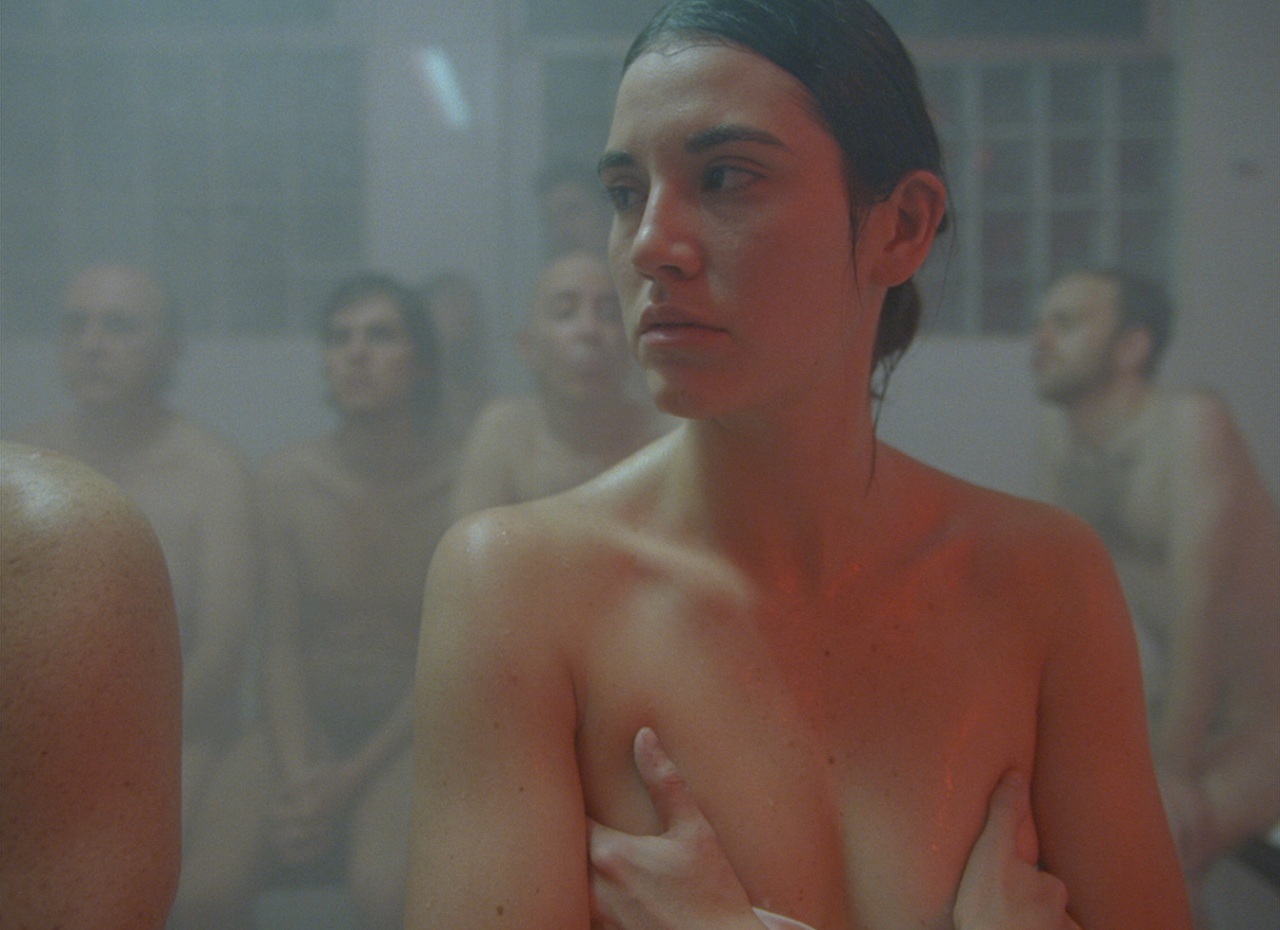
Figure 2. Your body is made for this
The orgy (and possible rape) takes place in a French bathhouse, a labyrinth of rooms where different scenes unfold and the barely-robed or nude participants watch and/or engage. Eventually Natalia lays on her back and strange men, of different ages and body types, begin to surround her. An older woman, Valerie, is encouraged by her male companion to go to Natalia. Natalia rests her head in Valerie’s lap, Valerie strokes the side of her face and offers her encouragement and support.
“It’s fine. Relax. Just enjoy it.”
“OK.”
“Your body is made for this. You must let go.
Do you feel better now?”
“Yes.”
Natalia’s arms lay at her side, she does not look at the men she is allowing to use her body, or the ones watching, or her husband, or communicate with them at all, only Valerie.
“They all want you because you’re beautiful.”
“Yes. Thank you.”
“This is a pleasure for me, Natalia.”
So it is not only Natalia (and perhaps Juan) who have mastered a kind of inactivity, a vegetative state where things are done to you and in front of you and you accept them because that is how you were made. It is also Valerie who is revealed to be “doing” by the end of the scene, when it appeared as if she too was allowing things to happen. In fact, this is how Valerie has learned to master her own “inactive” pleasure.
But there are other ways to interpret non-mastery here which are far less salutatory, and become more evident from a critical feminist standpoint. Specifically, one cannot help but also view this entire scene as a rape, whether literal or metaphorical.6 Literal, because on some level Natalia resists this and has to be encouraged by another woman to accept her lack of agency in the sexual encounter for which she was “made.” Seen in this way, the scene provides a commentary on the public secrecy of sexual violence and its dependence on forced acquiescence and de-subjectivation (the dehumanizing dangers of becoming plant, that is). Metaphorically, the scene raises the specter of sexual violence, regardless of what the actors or characters think is happening. The spectral possibility of rape arguably haunts this scene for anyone watching who lives with that specter on an everyday basis as a survivor or pre-victim. In patriarchal social formations (and it has been well-established by this point in PTL, Natalia exists in one), everyday feminine existence is haunted with the spectral possibility of sexual violence (Burke 2019). Philosopher Megan Burke goes further, suggesting, first, that this is often imbricated within other forms of racial and gendered oppression and, second, that whether or not someone has suffered trauma, the spectral scene of sexual assault is lived and in an undeniable, embodied way. “You must let go.” What is being let go of? It may not only describe mastery, in this reading, but the ability to choose relationships, feelings, encounters, a future of one’s own.
How does one become-plant? “Becoming-plant is the emission of particles from a heterogeneous alliance we make” Karen Houle argues. This emission “expresses in action the unique qualities of plants or plant-lives. These qualities would, in principle, not be the same qualities as those of women or women-lives, nor of canines, nor of children and childhoods.” (Houle 2011:97). What is Natalia “made for”? This could be taken as an expression about her nature as a woman, and the qualities of submission specific to some women-lives. On the other hand, complete immobility in exchange, with particles swapping through a surely heterogeneous alliance (for what else is an orgy?), does sound very similar to the unique qualities of plants and plant-lives and the forms of signaling and chemical communication they have been found to engage in.
Is every tree a Natalia? Perhaps when they become objects of male fantasy and desire. The next shot is an avocado tree with a donkey roaming in its shade. Animal with tree. It is hard to see this transition as an accident. Who has mastered a non-masterly relation to nature if not this donkey? Then dogs and a man emerge. We are back in Mexico, land of dogs. Siete is late to cut down another tree. Once again we see a boss abuse dogs while an employee watches. This man, Glove, wants their tree cut down quietly. The tree will mess up his field, dropping leaves everywhere, Glove explains. But he also wants to cut it down to annoy his sister, who he says is a killer who he’ll shoot on sight. She thinks trees are alive in the way animals are, that they talk and fuck, he says. In the previous scene, we just witnessed how people can be alive in a way like plants are, through exchange and stillness, even while they ostensibly talk and fuck like people.
It is then that we discover that we are not just back in Mexico, we are back in time, or perhaps on an altogether different timeline. Natalia and Juan and their children are young again. The scene is overrun with binaries.
Patron and Employee
Mexican and White
Country and City
Native and Foreign
These trouble any formation of an animal pack, an assemblage that would render these binaries meaningless or denude them of power. They also provide support to Bollington’s (2017) argument that post-human approaches need not disavow racist or precarious social formations, but can give them new expression. I would argue, however, that PTL does not transcend these differences but only restages them in troubling ways. For example, Juan finds his plant self, his vegetative semiosis only through an act of racialized class violence. Siete and another, seemingly indigenous Mexican break into the white family’s home in an attempt to steal electronics. They unintentionally injure him, a pack out of control, leaving Juan bed-ridden and solitary.
As with Natalia, it is through force that a vegetative peace is found, this time associated with the explosive racial and colonial tensions that characterize Mexico, rather than patriarchal control. Only now does Juan find peace, he says. In fact, only now is he cured of the sickness that afflicted him. He has been sick, he tells Natalia in a moment of revelation.
“Today I felt as I did when I was a child.
The grass of Cuernavaca under my feet.
How it pushed between my toes.
I could feel every blade.
It was so cold at dusk.”
Becoming with plants at the witching hour.
“I saw how everything is alive. Shining. All of the time.
I felt like a newly cleaned baby. Clean and dry.”
This could be taken as a troubling commentary on racialized encounters in Mexico, that is, even in situations of resistant violence and theft, indigenous people remain a means or tool for elite, white self-discovery. Suddenly everything is alive, all of the time shining. This is matrix of mutual-relation that normally only plants would perceive or, perhaps, eavesdrop on, which is now evident to a privileged white man who has given up on dominating himself and others.
The coloniality of semiotic becoming continues as the film progresses. If Juan gets peace in a plant-like state, which may or may not conclude in death (it is unclear), Siete’s journey after the violent encounter is not so simple. Siete had previously attempted to cure his pain by drinking. “Drunkenness as a triumphant irruption of the plant in us,” Deleuze and Guattari write (1987:11). But it is always, sadly, temporary. The burdens of becoming-animal return again. In order to be a better husband and father, Siete then sought out a cure by being “interred” at an anexo. Later he would try to commit to this by attending AA meetings at a shack in the woods. We see one of these meetings and learn, through his narrative to Juan, that Siete’s very name (“Seven”) is linked to his attempt at cure, with his having spent seven months spent at an anexo treatment center. Angela Garcia places PTL in conversation with her ethnography of anexos and their troubling history as an informal treatment option for the rural poor. They are considered hellish settings by the mainstream Mexican media, yet they fill a gap in the hollowed-out, neoliberal context of the last several decades:
Recovery is a concept central to addiction and the neoliberal Mexican state. In both contexts, the concept embraces the individualization of health, wealth, and the potentiality of being, either through a process of personal transcendence or by social and economic reform. (Garcia 2017:105)
For Siete and his companions at the AA meeting, recovery “refers to a mode of life whose major theme is the common work of endurance” (ibid.). The contradictions of this path of recovery, of trying to be a good pack animal, are made painfully apparent to Siete after his return from the anexo: “Siete came back home to find that his wife and children had left him. His hoped-for future, which hinged on his recovery in an anexo, did not materialize” (ibid.).
After the attack on Juan, Siete is racked with guilt for what he has done and yet goes unpunished for it. Juan has no memory that Siete is the one who shot him. Still, Siete is on the run. The truck he is in runs over a dog and he does not react. This is worth comparing to the multiple scenes of dogs beaten. These previous episodes had been death by means of active violence, far from animalistic, these beatings were part of a sickness that arose from not being able to join the pack, from wanting to and being unable or incapable. The exuberant joy of the robbery ended in violence in the same way that the triumph of drunkenness always ended in sobriety, there was no way out. Running over a dog with indifference, by contrast, could be seen as a refusal of that desire altogether, a rejection of that search and the pain it wrought, if not on Juan, then on himself. The drive is taking Siete to see the family he had left and that left him. It is dusk again. The dogs bark as he approaches their home. His son is digging a hole. His daughter runs up to hug him. Siete’s wife, Samanta, stares blankly as he embraces her. She does not hug back, remaining stiff. This is only for the sake of the kids, she says. Eventually she closes her eyes, but remains firm. This might be the clearest expression of the mastery of non-mastery in this film, of giving oneself over to a way of being that I have characterized as vegetative or phytosemiotic.
Siete visits Juan’s home and the two children are playing alone. Eleazar says his father has died. When Siete returns home, Samanta is gone. Was she ever there? A gunshot rings in the air. Fired by whom? At whom? Has Samanta killed herself? Him? The children? Is their absence tantamount to the shot that got Juan and gave him peace?
In the next scene the demon is back with its tool box. Eleazar sees it again, only now he is older. Is it there for him this time? Will he begin the same hopeless search to master his desire? In the penultimate scene, we see Siete again. It is a death march. There are no dogs and no people. It is just him and the trees he kills for money, sometimes illegally, sometimes to piss off someone’s sister. As he stands there, a tree falls, then another, then another. They don’t need him to make them come down, they fall all on their own when it's time, they submit to wind and gravity. They are the masters of non-mastery and show him what this means. “Plants do not differentiate between inside and outside,” Pouteau (2014) writes, “Their loss of leaves, their loss of branches, cannot make them similarly headless because they are unsplit.” And yet Siete becomes unsplit: raising his head to his hands he engages in an impossible act of self-decapitation and then he is like them, he has somehow assumed their nature and, in so doing, acquired their peaceful descent. Bollington relates this to Kohn’s analysis of biosemiosis:
In his final moments, however, Siete changes perspective in relation to the forest, becoming the severed tree rather than the severer. He has lost his position of dominance and is now the slain meat rather than the ‘hunter’, the fallen prey rather than the dominant, surviving ‘I’, to invoke Kohn’s terminology. (2017:152)
I would only add that Siete appears less like slain meat and more like fallen branches. After he does so, the world around him remains serene, it starts to rain. The animals come to drink the water (not to pick at his carcass). It is the field of Rut’s opening dream. Now we are shown how trees live in the storm with which the film began, when the sun is gone.
The final scene takes us back to England. Eleazar is a teenager playing rugby. Has he been visited by the demon, is it his fate to resist becoming animal, to fantasize being a lone wolf he’ll never be and hurt the ones he love? Not for now, the team is a chaotic and meaningful pack, “they’ve got individuals, we’ve got a team” someone says, “Come on let’s go.” One is reminded of the earlier line, differently gendered, in the scene of orgy/rape and Natalia’s becoming-plant, “you must let go,” or of Juan finally letting go when incapacitated. Eleazar begins his own journey into the hoped-for open-ended multiplicity of pack life, but is he also doomed to failure and destined to find a violent peace through becoming-plant?

Figure 3. Siete becoming plant
Conclusion
In The Open, Agamben describes as “anthropological machines” the processes by which human beings and animalized/dehumanized others are alternately excluded and included from the category of the human. Both the humanization of animals and the animalization of humans serve to continuously redefine who counts as human and what does not (Agamben 2004:36-38). But any individual creature, human or non-human, is more than this general category of the animal. In keeping with Victoria Lady Welby and Jakob von Uexküll’s biosemiotic approach, actual, lively beings destabilize human mastery over linguistic categories and natural kinds alike. Like Jacques Derrida’s infamous cat, caught regarding his owner’s naked body, they return a gaze that raises the specter of an ethical demand (Derrida 2008; Krell 2013). Derrida discusses his cat in his unfinished book, The Animal That Therefore I Am (2008), which David Farrell Krell points out, has a double meaning in the original French, the animal that therefore I am and the animal that therefore I follow. The capacities that (most) animals possess to varying degrees—to move, to hide and seek, to suffer and learn from experience—also allow humans to become with them in dynamic ways. “Human nature is an interspecies relationship,” Anna Tsing argues (2012). And this is no more obvious than with the creaturely companions that we raise and bring into our homes, to kill and eat, to nurture and let die (Haraway 2008).
In multispecies ethnography and theory, animal, microbial and even fungal kingdoms have been much discussed, but that of plants less so. “A specter is haunting animal studies,” T.S. Miller writes, “the specter of cellulose” (2012:460). In some ways, this apparent zoocentrism may be the paradoxical result of a desire to avoid the allure of anthropocentrism. After all, when compared with lively animals or elusive microbes, plants appear like the ideal counterpart to fantasies of masterly domestication. They return no gaze, they do not appear to suffer, lacking movement they do not normally accompany, but they are powerful consociates all the same. All one need do is consider the awesome yet humble role of cereals in mastering non-human and human natures, from the rise of the state to European colonialism (Tsing 2012:145-49). Agamben also outlines (but does not name) a zoological machine engaged in a similar procedure as its anthropological equivalent. This would be a set of practices and projects that seek to delimit the animal as something distinct from, perhaps superior to the plant, its other. For centuries, from Aristotle to Bichat, vegetative powers have been considered an organic life underlying our animal existence. The purely nutritive, autonomic functions of breathing, circulating and excreting “mark out the obscure background from which the life of the higher animals gets separated” (Agamben 2004:14).
For animals, such as humans, to become-plant raises normative questions about beginnings and endings, making live and letting die. Agamben goes on to associate this vegetative state underlying animal life with the bare life of biopolitical discipline: as in definitions and debates concerning clinical death, and the implementation of general anaesthesia in surgical practice. The characters in PTL do not reaffirm the zoological machine with reference to vegetative being as a state of exception, but rather explore desires and capacities for transformation to escape from the anthropological machine and the (demonic) alliances thereof. And yet, these transformations are not easy. They come only by reckoning with histories of patriarchal, colonial violence that characterize Mexican life.
Paraphrasing Walter Mignolo, the way in which PTL engages with these tensions amounts to a form of colonial bio-semiosis. For Mignolo, colonial semiosis, “Brings to the foreground the following dilemma: what is the locus of enunciation from which the understanding subject understands colonial situations?” (1989:335). This is central because colonial situations are defined by “the domination of one culture (its history, institutions, and individuals) over another” including its prevailing way of deciding who can communicate and how (Mignolo 1995:16). This could be a gloss on the entire project of bio-semiotics, what Mignolo adds is a concern with the shifting and twisted interpretations characteristic of colonial modernity. As I and others have discussed, Reygadas’s camera and the scenes he stages deliberately resist a clear locus of enunciation. Sometimes we see from the point of view of Siete, Juan, Natalia, Eleazar (with a parallax lens to make it feel like an organic perspective), sometimes it is unclear whether we are seeing dream, reality, or distorted memory, and through whose eyes. What is clear is that the “essences” at play are not only animal and plant but sedimented divides associated with class, race, gender and generation. What becoming plant offers filmmaker and viewer, are challenging mixtures that arise from the unwinding of these divides. We do not and cannot escape them, but becoming plant allows us to restage them, albeit in unequal and frequently violent ways.
In this review, I divided the action in PTL between the demonic tampering (literal, in this case) that sets the characters on a path of desire and culminates in the destructive peace of mastered non-mastery. This comes for the three main characters, one after another, when they transgress the zoological machine and violently become-plant in different ways. But the fact that this comes at the cost of movement, of life, and of hope does not bode well for our animal protagonists. How could it when colonial semiotics and specters of sexual violence haunt their interactions?
Perhaps there are ways to unwind our domination of nature or, as I have glossed it, our becoming-animal, that are less permanent, less violent. Caring for plants, in the era of the Anthropocene, has often taken the form of “biomass speculation” (Mackenzie 2014). The same year as PTL was released, the World Bank announced a revision of their Reducing Emissions through Deforestation and forest Degradation plan (or REDD+), which would provide $725 million to projects to produce mass forestation in the country (Matthews 2014:104). But, as Andrew Matthews (2014) explains, this has been dogged by corruption and scandal. He points out, in that essay, that uncertainty and “non-knowledge” need not be an impediment to climate policy and action, but can drive potentially helpful projects if engaged with correctly. One way to characterize engagement and acceptance of non-knowledge is as mastery of non-mastery. To truly accept it, the World Bank could do worse than to admire the unsplit and semiotic properties of individual trees, rather than seek to dominate whole forests. This means rethinking both ourselves and plants. This is no small task. “In spite of enormous progress in biological knowledge,” Sylvie Pouteau argues, “vegetative, organic life still remains a rather obscure and abstract concept, and is still conceived mainly on essentialist and mechanistic grounds” (2014:6).
Reygadas’s films, not only Post Tenebras Lux, can be seen as another way to meditate on these issues, as I have argued. With the apocalypse around the corner, in no small part because trees are ablaze all over a choking and overheating world, surreal nonsense and non-knowledge may have important secrets to share.
Endnotes
1. An even better comparison, perhaps is the similarly celebrated, semi-autobiographical and surreal, Thai film, Uncle Boonmee Who Can Recall His Past Lives (2010). As in Uncle Bonnmee, the interspecies encounters imagined in PTL are provocatively perspectivist: they do more than reveal interconnected assemblages of humans and non-humans, they stage uncomfortable and passionate mixtures of their natures.↩
2. It is worth noting a distinction between biosemiotics, as used by Kohn and others, and what is usually described as “the ontological turn” in anthropology and social theory more broadly. Kohn (2015) explains the difference between these different approaches in general. Reno (2015) explains the difference between Kohn’s biosemiotic approach and that of other ontological turn advocates like Vivieros de Castro. Among other things, biosemiotics does not flatten differences between creatures who are different in kind—by virtue of the Linnaean class to which they belong (plants, animals, humans), living things communicate and relate differently. This places biosemiotics on the side of Aristotelian realism and directly in tension with more Spinozan/Deleuzian approaches. In this paper, I am less interested in differences between these theories and theorists than I am in seeing what they can do together to think about becoming-plant in PTL.↩
3. This is arguably different from the conception of hybrid plant-animals as monsters in fiction or speculative biology, see Miller 2012.↩
4. In making this argument I am not concerned with whether Reygadas would agree with my assessment, per se. More biographical treatments of film can of course be illuminating, as they can for any form of art or artifact. But there are also ways that works of art communicate about the world that go beyond the specific intentions of a director, writer, performer (see Gell 1998). This is even more the case for some of the scenes and scenarios that are depicted in PTL, as I will explain in what follows. ↩
5. Alain Beaulieu summarizes Deleuze’s perspective on animality as including, “An anti-psychoanalytic perspective through the critique of familialism; An anti-humanistic approach for which the animal behavior becomes exemplary in its capacity to express the power (puissance) of an impersonal life; The connections between animal and human creations as they leave their territories and settle down elsewhere; The becoming-animal of the writer and philosopher” (2011:72). Some, but not all of these features are discussed in this essay.↩
6. Thank you to an anonymous reviewer for calling this to my attention.↩
References
Agamben, Giorgio. 2004. The Open: Man and Animal. Stanford, CA: Stanford University Press.
Bruns, Gerald L. 2011. On Ceasing to Be Human. Stanford, CA: Stanford University Press.
Bollington, Lucy. 2017. ‘The Open Whole’: Human-Nonhuman Relationality in Carlos Reygadas’ Neo-Surrealist Post Tenebras Lux (2012). Bulletin of Spanish Visual Studies 1(1):139-60.
Burke, Megan. 2019. When Time Warps: The Lived Experience of Gender, Race, and Sexual Violence. Minneapolis: University of Minnesota Press.
Cossins, Dan. 2014. Plant Talk. The Scientist. https://www.the-scientist.com/plant-talk-38209.
Deleuze, Gille and Felix Guattari. 1987. A Thousand Plateaus. Minneapolis: University of Minnesota Press.
Derrida, Jacques. 2008. The Animal That Therefore I Am. Ann Arbor: University of Michigan Press.
Garcia, Angela. 2017. The Rainy Season: Toward a Cinematic Ethnography of Crisis and Endurance in Mexico City. Social Text 130(1):101-21.
Gell, Alfred. 1998. Art and Agency: An Anthropological Theory. New York: Clarendon Press.
Haraway, Donna. 2008. When Species Meet. Minneapolis: University of Minnesota Press.
Hershfield, Joanne. 2014. Nation and Post-Nationalism: the Contemporary Modernist Films of Carlos Reygadas. Transnational Cinemas 5(1):28-40.
Houle, Karen L.F. 2011. Animal, Vegetable, Mineral: Ethics as Extension or Becoming? The Case of Becoming-Plant. Journal for Critical Animal Studies (1/2):89-116.
Kaufman, Sharon. 2000. In the Shadow of “Death with Dignity”: Medicine and Cultural Quandaries of the Vegetative State. American Anthropologist 102(1):69-83.
Kohn, Eduardo. 2015. Anthropology of Ontologies. Annual Review of Anthropology 44:311-27.
Krell, David Farrell. 2013. Derrida and Our Animal Others. Bloomington: University of Indiana Press.
Laurie, Timothy. 2015. Becoming-Animal Is a Trap for Humans: Deleuze and Guattari in Madagascar. In J. Roffe and H. Stark, eds. Deleuze and the Non-Human, pp. 142-62. New York: Palgrave Macmillan.
Mackenzie, Adrian. 2014. Having an Anthropocene Body: Hydrocarbons, Biofuels and Metabolism. Body & Society 20(1):3-30.
Matthews, Andrew. 2014. Scandals, Audits, and Fictions: Linking Climate Change to Mexican Forests. Social Studies of Science 44(1):82-108.
McMenamin, Dianna L Shulte and Mark McMenamin. 1994. Hypersea: Life on Land. New York: Columbia University Press.
Mignolo, Walter. 1989. Afterword: From Colonial Discourse to Colonial Semiosis. Disposito 14(36/38):333-37.
Mignolo, Walter. 1995. The Darker Side of the Renaissance: Literacy, Territoriality and Colonization. Ann Arbor: University of Michigan Press.
Miller, T.S. 2012. Lives of the Monster Plants: The Revenge of the Vegetable in the Age of Animal Studies. Journal of the Fantastic in the Arts 23(3):460-79.
Petrilli, Susan. 2009. Signifying and Understanding: Reading the Works of Victoria Welby and the Significs Movement. Berlin: De Gruyter Mouton.
Pouteau, Sylvie. 2014. Beyond “Second Animals”: Making Sense of Plant Ethics. Journal of Agricultural and Environmental Ethics 27:1-25.
Reno, Joshua. 2014. Toward a New Theory of Waste: From ‘Matter Out of Place’ to Signs of Life. Theory, Culture & Society 31(6):3-27.
Reno, Joshua. 2015. Continuity and the Open Whole: a Comparison of Recent (Peircian) Ethnographies. Critique of Anthropology 35(2):220-31.
Stevenson, Lisa and Eduardo Kohn. 2015. Leviathan: an Ethnographic Dream. Visual Anthropology Review 31(1):49-53.
Taussig, Michael. 1993. Mimesis and Alterity: A Particular History of the Senses. New York: Routledge.
Taussig, Michael. N.d. Mastery of Non-Mastery in the Age of Meltdown. Unpublished Manuscript.
Tiago de Luca. 2015. Natural Views: Animals, Contingency and Death in Carlos Reygadas’s Japón and Lisandro Alonso’s Los Muertos. In Tiago de Luca and Nuno Barradas Jorge, eds. Slow Cinema, 219–30 (p. 225). Edinburgh: University of Edinburgh Press.
Tsing, Anna. 2012. Unruly Edges: Mushrooms as Companion Species. Environmental Humanities 1:141-54.
Von Uexkull, Jakob. 1992[1934]. A Stroll through the Worlds of Animals and Men: A Picture Book of Invisible Worlds. Semiotica 89(4):319-91.
Welby, Victoria Lady. 1903. What is Meaning? Studies in the Development of Significance. London: Macmillan.